Showing posts with label Temples around Chennai. Show all posts

Saturday, April 23, 2022

Murugeeswarar Temple, Thaiyur

The entrance to the Murugeeswarar Temple, Thaiyur

I had been invited to visit the Murugeeswarar temple at Thaiyur by Kaushik, a long-time volunteer of the Aalayam Kanden Trust, about three years ago. However, due to personal and COVID-19 situations, the visit did not happen. During this time, some of my blogger colleagues had the opportunity to visit and write about this temple.

Generally, Aalayam Kanden focuses on temples that are not popularly featured. So when Mr Uma Magesh, who takes excellent care of the temple, invited me again last week, I decided to visit, and make it a part of the monthly Aalayam Kanden Trust activity of distributing oil, ghee and vastrams at ancient and lesser known temples.While there, several things struck me about the temple, that I wanted to share my thoughts through this blog post.

Legend:

Lord Muruga mounted on a peacock with bow and arrow in hand

The sthalapuranam states that Lord Muruga had worshipped Lord Shiva here before proceeding to Thiruporur to fight Tharakasura. There is an old idol of Muruga placed in the Mahamandapa of the temple, believed to be made of sandstone. The legend says sandstone in Tamil was referred to as Thaijagam which gave the village its name. A pillar at the entrance of the temple has the icon of Lord Muruga on a peacock, bow in hand, setting out to fight.

Literary and inscriptional references:

The 15th century literary work "Uththandan Kovai" gives a great deal of background about Thaiyur. This work comprising of around 450 songs on Uthandan, a local chieftain, belonging to the Kalappalan clan (Mudaliars from Aamur Kottam to which Thaiyur belonged) describes the village as it existed then. This work whose author is yet to be confirmed, has been collected in portions, in manuscript form, by various sources such as the Oriental Manuscript library, the U.V. Swaminatha Iyer library, the Institute of Asian Studies and the descendants of Uththandan. These have been compiled to the extent possible by the Institute of Asian Studies and a bilingual publication titled "Poetic Verses in the Interior Landscape" has been brought out . The book brings forth various facets of Thaiyur which are worth mentioning, before we look in detail at the Murugeeswarar temple.

The word Thai (தை ) could be used to denote beautiful, joining or full of saplings. The Jatavarman Sundarapandiyan inscription at the Maragathavalli Ambal Shrine of the Murugeeswarar temple, describes the deity as Azhagiya Chokkanaar which probably indicates that Thaiyur meant beautiful village. Prior to the period of Rajaraja I, Thaiyur had been called "Thalasayanapuramaana Thaiyur". Thalasayana refers to the reclining Vishnu of Senganmal. Senganmal was a part of Thaiyur until the 15th century before it was seperated out as Irandaayiramvelipatru, and Thaiyur was labelled Ayiramvelipatru. We come to know this from the Senganmal temple mandapa inscriptions. 

Inscriptions at the base of the Murugeeswarar temple Thaiyur

Six inscriptions found in the Nithyakalyana Perumal temple of Thiruvidanthai mention grants given by people of Thaiyur. While three of them that belong to a period prior to Rajaraja I, refer to the word Thalasayanapuram, from the time of Rajaraja I it came to be called Jayamkonda Chola Mandalathu Aamoor Kottathu Aamoor Nattu Rajakesarinallur. During the Vijayanagara Period, Aamoor Nadu came to be referred as Kumuzhi Nadu. Kumuzhi referring to a place surrounded by water bodies extending from ponds and lakes to the ocean. It is during the time of Veerapratapa Achutharaya (1536 CE) do we find the mention of the word Thirumurugeeswara Nayanar which is the current name that the deity is referred to. This inscription spreaks about grants given by a person from Thiruvidanthai to the temple to repair it and carry out worship.

Period of the temple:

The Chandikeswara at the Murugeeswarar temple, Thaiyur

From some of the deities such as Ganesha and Chandikeswara present in the temple, we can derive the original period to be between the 9th and the 10th century CE. Majority of the current construction dates between 13th and 15th Century CE with the external superstructure a classic representation of the Nayaka period.

Antiquity:
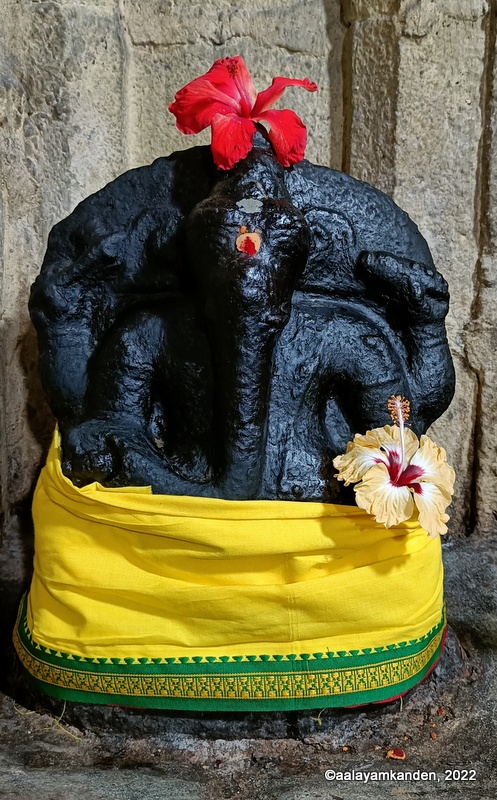
Ganesha with the inscription "Sri Urumetru" at the Murugeeswara Temple, Thaiyur

The oldest deities at the temple are the Ganesha found in the Mukha Mandapa and the Chandikeswara in his destined position. The Ganesha is found without the usual pot belly with a single line inscription at the base which reads "Sri Urumetru". Dr Ramachandran, Senior Epigraphist, has interpreted this word as denoting heavy thunder. He states that this could probably refer to the Pallava title "Pagapidugu" and might belong to the later Pallava (Aparajitha or Kampavarma) period. However, he urges further research into this.

Lord Muruga believed to have been made of sandstone

There is no mention about the Muruga found in the Mukha Mandapa in any inscription so far read. His consorts are of a later period, and there are other deities like Chandikeswara, Mahavishnu, Kasi Viswanatha and a goddess, probably moved here from another temple, that was lost to time, placed in a tableau around him. Research says that there was a Vishnu temple in the village that had become dilapidated, and fearing invaders, the deities had been buried. Chances are that some of them were subsequently excavated and placed here. It also explains why there are three Murugas around the same place.
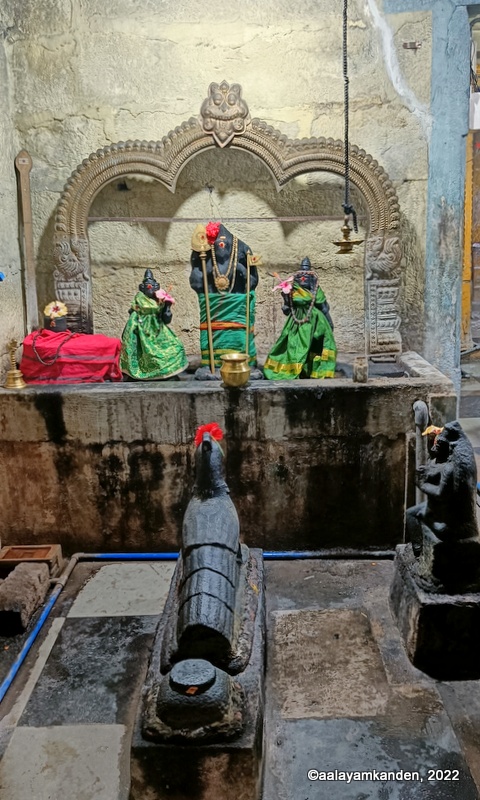
The pavilion around Lord Muruga at the Murugeeswarar temple, Thaiyur

Deities:

Lord Shiva is found in a beautiful sanctum with typical Nayaka period miniatures on either side of the door jamb, including a donor (mentioned in the inscription) who is lighting a Nanda Vilakku. The Artha Mandapa has the Ganga and Yamuna depiction, which would usually be found while entering the temple. The bronze Bhoga Shakthi of this temple has been moved out for safe keeping, and a stone replica has been placed at a later date within the sanctum. Apart from the two inscriptions already mentioned, a stand-alone stone inscription from 1565 CE of Thirumalai Deva Maharaya period refers to the deity as Thirumurugeeswaramudaiya Thambiraanaar. So it is evident that from the Vijayanagara period, the current name has been in vogue.

Lord Murugeeswarar of Thaiyur

Goddess Maragathavalli Ambal is found in a seperate shrine, holding Pasa and Ankusha. The shrine seems to have been constructed/renovated during the Pandya period. 

Maragathavalli Ambal of Thaiyur

The Koshta deities are all beautiful and the depiction of various mythological stories, such as Kirata-Arjuna, Kannappa Nayanar and Vyagrapatha and Bheema have been shown in the exterior walls in sequences. 
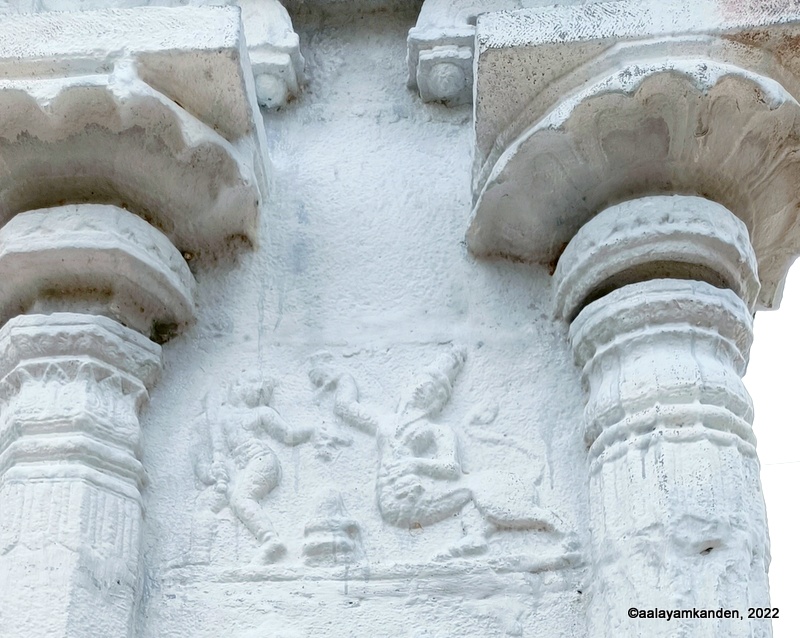
Vyagrapadha and Bheema episode at the Murugeeswara temple Thaiyur

Whatever is shown on the walls in the Southern side, goes up into the Naasikoodu (Alcoves) in the Northern side, showing that by worshipping God, a devotee can get spiritual elevation. The vimana of the temple is a three tiered structure, more like a Gopura. 

The vimana with the beautiful Naasi Koodus

The Kumbapancharas have playful monkeys jostling about with each other. There is another Ganesha shrine and a Subramania shrine in the circumambulatory path.

Kumbapancharas showing playful monkeys at the Murugeeswara Temple Thaiyur

Social initiatives:

The temple has a beautiful Nandavanam and Mr Uma Magesh has been taking special efforts to grow several herbal plants and trees within its campus. Mango tree is the sthalavriksham of the temple. He is nobly supported by a good team of volunteers from the nearby apartments who come every week, to clean the temple, clear the nandavanam and water the plants, wash vessels and clothes. The temple  even has a washing machine for this purpose. It was a pleasant sight to see these highly placed men and women contribute their weekend towards the upkeep of their neighbourhood temple. If only many more people come forward to spend a couple of hours at the temples in their neighbourhood, every temple would look as clean and green as this one.

The Nandavanam at the Murugeeswara Temple Thaiyur

While all this is appreciable, the whitewashing of the exterior walls is an eyesore. The nuances of the sculptures as well as the inscriptions are hidden within. If the temple gets help from volunteers to clear this without damage, it would restore the original look and identity.

Other temples in the vicinity:

Two other Shiva temples - the Mareeswarar temple and the Jalagandeeswar temple are found close to the Murugeeswarar temple. Two Ganesha temples, one built by Uthandan, next to where his palace was, and another of a later period are also found.

How to reach here:

Thaiyur is situated about 12 kilometres from Mamallapuram and 3 kilometres from Kelambakkam on the Old Mahabalipuram Road in Chennai. Once a very fertile agricultural village, surrounded by Thaigai hill (today's Pudhupakkam), tanks, ponds, lake and the sea, today is part of the IT corridor. The GPS coordinates of the temple are: 12.7780677,80.1913894

Temple Timings:

The temple is open between 7.30 am and 9.30 am in the morning and 6 pm to 8 pm in the evening

Contact details:

Mr Uma Magesh - 9940126814

Tuesday, October 24, 2017

Vayalanallur Kandaswamy!

Kandasamy Murugan at Vayalanallur
This post is two years late. Although I had visited this temple first in 2015, and then several times since, even taking people on heritage trips, I never got around to writing about the Lord who had become one of my favourites. As I have always seen in Aalayam Kanden, everything happens with His will and he has willed that this post be written on the account of Kanda Sashti in 2017 and so here it is. 

Two years of documenting the temples along the Cooum threw open several rare heritage treasures. One such priceless treasure is the Murugan temple at Vayalanallur. The Topographical List of Inscriptions of Madras Presidency Volume 8 by T V Mahalingam was one of my guiding documents for my study and it spoke about three temples in Vayalanallur, one of which was a Kandaswamy Murugan temple, the second a Durga temple and the third, the Shakthimutreswarar temple.

The current status of the Kandasamy Murugan Temple with the Aditya I inscription luckily intact
Our search of the temples led us first to the Komaleeswaranpet temple, at Kolappanchery. We met Nagahariharan, the priest at Kolappanchery who incidentally mentioned that he was the priest at the Vayalanallur Murugan temple and offered to take us there. He has been conducting the poojas as a volunteer for some years now, purely because his Kuladeivam (family deity) is Murugan.

We were touched by his commitment and followed his two-wheeler into a narrow lane. What would have once been a huge temple, has now been reduced to a single shrine. " Nobody comes to the temple, except on important festival days such as Panguni Uthiram or Thai Poosam where we somehow collect enough money to offer food and prasadams to attract a decent gathering,"said Hari as he opened the door of the temple.

We were awestruck by what we saw. By far, the most magnificent of the Brahma Sasthas that we have seen in that region, stood before us on the floor. Over seven feet tall, with an Akshara Mala in his hind right arm and a Gendi on the left, he stood with a smile turning up the corner of his lips.  There was no pedestal below his feet, no garlands around his neck nor any adornments. Just a humble vastram was all that he had.

The magnificent Murugan at Vayalanallur
Hari offered the prasadam he had carried from his house and performed Harathi. We were moved. All that remained of the antiquity of the temple, was the inscription from the time of Aditya I  (895 AD) about a gift of land made to the temple by Gunakirti Nambadugan, the Kilan of Ayandampakkam for Sribali and other services at the temple which is still found on the footsteps of the temple.

A total of four inscriptions were recorded in Annual Report on Indian Epigraphy 1952-53 as follows:

ARE 1952-53 no 226 three fragmentary stones in Murugan temple Aditya I RY 24 - 895 CE, registers gift of land made by Gunakirti Nambadugan the kilan of Ayandampakkam to the village for expenses of Sribali and other services to god.

ARE 1952-53 No 225 - On a slab in compound of same temple Chola Parthivendravarman r.y.5 - 961 CE - Seems to register the gift of tax free land by a native of Ayandampakkam in Pulal Kottam to the God Sattimutrathudeva of Vayinanallur in Puliyur kottam.

ARE 1952-53 - No 228 - On two slabs same place damaged - Parthivendravarman R.y. 8 - 964CE - records a gift of land made tax free. Mentions Pillaipakkam in Mangadu Nadu

ARE 1952-53 No. 227 - On a stone lamp post in the same place - Rajaraja I - seems to commence with the historical introduction - Kandalulr salai. Mentions a vellala of Sirupuliyur and the God of Vayinanallur situated in Puliyur kottam.

The Shakthimutreswara temple next to the huge temple tank had been lost to time. A look at the gigantic deity gave us an idea of how large the temple would have been in yore. The three inscriptions of this temple, two from the time of Parthivendravarman and one from Rajaraja I have disappeared along with the original temple and several deities that stood there. 

The Shakthimutreswara when we saw him first in 2015
When we enquired with Hari about the Durga temple he did not know much as to where it once stood. However, he remembers villagers saying a huge goddess was lowered into a well because it had become damaged! 

Several deities have been found while excavating around the original site of the Shakthimutreswara temple out of which a Bhairavar has been installed in the Vishnu temple and the Surya placed next to the Shakthimutreswara.

With the grace of the Almighty and generous patronage from the loyal supporters of Aalayam Kanden, we have been successfully supporting the Thai poosam festivities at the Kandaswamy Murugan temple over the last two years. 

Supporting the Thai Poosam festivities through the Aalayam Kanden Trust
The Shakthimutreswara temple has since been rebuilt in a small way, and the deity has found a secure place inside the sanctum.

The Kandaswamy Murugan has since became a member of the Aalayam Kanden family and he was gracious enough to bless the first copy of "The Gods of the Holy Koovam" which was the compendium of ancient sites along the Koovam. 

The Kandaswamy Murugan with the first copy of The Gods of the Holy Koovam
The temple still has very little support or patronage. As we celebrate the victory of good over evil on this Kanda Sashti, let us do our bit to protect and patronise the rare heritage treasures still left among our midst!
Kandasamy Murugan in all his glory after Thai Poosam alankaram
How to reach here: The temple is about 2 kms from Kolappanchery. From Kolappanchery head North. Pass Chokkanallur bus stand and turn right. The temple is on the left. Bus route 54C from Poonamallee to Thandarai is available once an hour. GPS Coordinates : 13.08565622, 80.06954102

Temple Timings: Please inform the Gurukkal before going and he will ensure the temple is opened.

Contact Information: Naagahariharan 90031 54640


Sunday, February 22, 2015

Enchanting Eri Katha Rama!

Baggout Top post on IndiBlogger.in, the community of Indian Bloggers

Thiruninravur Eri Katha Ramar Temple
The mention of Thiruninravur immediately brings to mind the magnificent Bhakthavatsala Perumal temple and the divine Hridayaleeswarar Temple. (The Articles on Bhakthavatsala Perumal Temple and Hridayaleeswarar Temple on Aalayam Kanden can be accessed by clicking the links).

But equally if not more enchanting is the Eri Katha Ramar Temple that is tucked away in a lane opposite to the Bhakthavatsala Perumal Temple. The temple is practically unknown to the tourists who flock the two other temples. But for the locals who show this temple some love and the discerning traveller who takes time out to check for other interesting sites enroute, this temple is practically empty.

There is no signage either outside or in the temple. Also there is no gopuram or large vimanam to draw attention. But when one takes the effort to enter, they are sure to be awestruck in many ways than one.

History of the temple:

This temple is said to be older than the Bhakthavatsala Perumal temple. It is found on the banks of the Thirunindravur Lake (Thiruninravur Eri) originally known as Varuna Pushkarni. It is believed that this lake was flooded in a storm and the bunds were in the verge of breaking when the villagers prayed to Lord Rama. Lord Rama is said to have created a fence of arrows around the lake that prevented it from breaking whereby the village was saved. The villagers showed their gratitude by building a temple on the banks of the lake for Lord Rama.

Varuna Pushkarni at Eri Katha Ramar Temple Thiruninravur
The Purshkarni is right behind the temple and one look at its massive expanse gives an idea of what would have been the damage if the bund had been breached. Even a couple of years ago, they say,that the Pushkarni used to be full of water and the annual Theerthavari used to be conducted on Panguni Sravanam.

The massive expanse of the Varuna Pushkarni
Apart from this, the annual Brahmotsavam and Rama Navami festivals are celebrated with a lot of festivity.

One of the noteworthy episodes connected with the temple is associated with the birth of Mudaliyandan a disciple and associate of Saint Ramanuja. Saint Ramanuja's sister Nachiyarammal and her husband Vathoola Kula Thilaka Sri Anantha Narayana Dikshithar who stayed in the nearby Nazarathpettai were on a pilgrimage to Tirumala to worship Lord Venkateswara to seek the boon of childbirth. As night fell, they rested at the Eri Katha Ramar temple at Thiruninravur.

During the night, Lord Rama is said to have appeared in the dream of Sri Anantha Narayana Dikshithar promising that a son who was an amsam of Lord Rama would be born to them. When the son was born, they named him Dasarathi, after Sri Rama. Dasarathi became a disciple, devotee and associate of his maternal uncle, Sri Ramanuja and since his demeanor was such as Vishwaksena, (Senai Mudhalvar), he came to be known as Mudaliyandan.

The temple:

On entering the temple, the first shrine is that of Anjaneya as usual. Just outside the Anjaneya shrine, is a stone pillar with Sanku Chakra and the image of Anjaneya which seems to be from the original temple.

Hanuman Shrine at the Eri Katha Ramar Temple, Thiruninravur

The stone pillars with images depicting various Avatars of Lord Vishnu have been poorly plastered with concrete.
Kalki Avatar?
In the Artha Mandapa, is a very unique depiction of Lord Anjaneya. Carrying Rama and Lakshmana on his shoulders, with the demoness Lankini under his foot, carrying a mace and shield in his arms, this very unique idol of Sri Anjaneya is said to be found only in Naimisaranyam apart from here.

Lord Hanuman carrying Rama and Lakshmana on his shoulders
with Lankini under his foot
One is able to go around the idol and obtain the darshan of the feet of Lord Rama and Lakshmana too.

Padha Darisanam of Sri Rama and Lakshmana
We are now ready to witness the most awesome of all sights. The more than eight feet tall Kothandarama, with two arms, holding bow and arrow, flanked by the weaponless Lakshmana to his left, whose right hand is held in such a way as if he was holding a horizontal bow, and the gracious Sita Devi holding a Lotus in her hand.

The sanctum Sanctorum - just to give the size of the Lord against humans!
No picture can do justice to the beauty of the Lord within the sanctum sanctorum, let alone a poor mobile phone picture! The beauty of this Rama, has to be seen to be enjoyed! It is also interesting to note that these images are not made of stone, but of stucco, which probably is yet another reason that they look so captivating!


The magnificent Eri Katha Rama at Thiruninravur

At the moment, the temple is in need of patronage, especially rice for aradhanam and oil and ghee for lamps. Monetary support is also most welcome.

How to get here:

Thiruninravur is about 32 kms from Chennai and can be accessed by road, bus or suburban train. The temple is few feet away from the Bhakthavatsala Perumal Temple. 

Temple timings:

Morning - 8.30 - 11.30 am
Evening - 5.30-7 pm
Shri Narayana Bhattar who is the Bhattacharyar at the temple is currently unwell. Therefore, Shri Venugopal Bhattar who is taking care of the Anjaneyar Sannadhi at Bhakthavatsala Perumal temple is also taking care of this temple. So in case you find the temple closed, you may reach out to him at the Anjaneyar sannadhi or at his house on Car street.

Contact Details:
Venugopal Bhattar - 78457 85715/ 98408 37689


If you happen to be in Thiruninravur, please take time to visit the Eri Katha Ramar Temple too!

Friday, July 11, 2014

Shattered Splendour!

Idols in front of the Shenbageswarar Temple at Natham Parameswaramangalam
Natham Parameswaramangalam - The name might ring a bell to history and heritage enthusiasts. Not before long, two temples in this little village along the ECR were in the news. The first, the extremely picturesque Kailasanatha temple, right in the middle of Palar River, and the other the Vaasthu Devapathi Perumal Temple, where bronze icons belonging to the Pallava era where unearthed during renovation.

Both these temples have now been completely renovated and have regained their lost glory and patronage. But there is yet another beautiful gem lying in the dust in the same village - the Shenbageswarar Temple.

The beautiful Kailasanatha Temple in the middle of Palar River
History of the temple:

Goddess Lakshmi chose a "Shenbaga Vana"(a forest of Champak trees) to install a Shivalingam and pray to it. She meditated for several years before the Lord. Pleased with her devotion, Lord Shiva appeared before her. Nandi Deva followed Goddess Lakshmi into the Shenbaga Vana and stood guard to see no harm presented itself to the Goddess or the Lord. Because of this, he is seen till even today, with his back to the Lord.


He blessed her saying the place she chose to worship him would always be special and even Goddess Soundaranayaki would assume the adornments of Goddess Lakshmi by giving up the Paasam and Angusam and holding the Lotus and Nilothpalam in her hands. Moreover, the first honours would always be offered to the Goddess in this Kshetram. Having said this, he left the Shenbaga Vana and moved up a small hillock on the Palar river and manifested himself in the midst of the wilderness.

Goddess Soundaranayaki was distraught that her husband had left her all alone at Natham and went looking for him. He had by then hidden himself in the midst of the wilderness, in the company of a snake that shielded him from the elements and a cow that showered its milk on him.


The Sthalapurana Idol at Kailasanatha Temple
The Goddess in an attempt to convince her Lord to come back to his abode in the Shenbaga Vana is said to have moved up the hillock on her knees, the imprint of which is still found in the circumambulatory path around the Kailasanatha Temple.

Goddess Soundaranayaki's knee impressions on the rock up the Kailasanatha Temple
The temple is said to have been originally built by Nrupathungavarma about 1200 years ago and then subsequently strengthened by Kulothunga Chola I , and then by Maravarman Sundarapandiyan.
Usually we find Shiva temples have five Goshtams featuring Ganesha, Dakshinamurthy, Lingodhbavar or Vishnu, Brahma and Durga. However, this temple has seven Goshtas, each one of them more beautiful than the other - comprising of Bhikshadana, Ganesha, Dhakshinamurthy, Lingodhbhavar, Brahma, Durga and Harihar.

The One-legged Bhikshadana :(
As you can see in the picture, there are inscriptions all along the walls of the temple. These inscriptions bear testimony to the patronage by the glorious kings of yore. King Raja Raja Chola I's queen Sakthi Thanthi Vidangi (Lokamahadevi) has been instrumental in converting the barren lands near the temple into fertile agricultural lands and then donating them to the temple for its upkeep and maintenance. During the rule of Rajendra Chola I in 1015, he has appointed a Sathvanjara Committee to discuss and explore Town planning. During the time of Kulothunga Chola III, a 16 pillared mandapa was built outside the temple.


It is sad to see that this mandapa has been brought down by the natural elements and passage of time, and portions of it have been used to create a mandapa over Nandi. Apart from this there are seven Shivalingams found along the Goshtas around the temple. These are known as Kailsanatha, Shenbageswara, Arunachaleswara, Jagadeeswara, Ekambaranatha, Valmikinatha and Vyagrapatheeswara.

Scattered Shiva lingams around the temple
The temple did not have vimanas for the Swamy and Ambal shrines earlier and it is really sad to see that when a donor came forward new cement vimanas have been built over the heritage structures threatening their stability and sustainability. I truly felt the funds could rather have been diverted to strengthening the weather course and the flooring inside the Artha Mandapa.

The Artha Mandapa 
Each one of the dieties is a beauty in itself. Apart from the majestic Shenbageswarar who sits in the modest sanctum sanctorum which leaks throughout the rainy season, sometimes even putting out the few lamps lit inside, and the magnificient Soundaryanayaki who as her name denotes is a beauty unparalleled, even the other idols in the temple are unique.

Goddess Soundarambigai 
The Subramanya in this temple needs special mention too. With the peacock turned in the opposite side (Asura Mayil) and weapons in all his arms, he is said to have been installed during Rajendra Chola I's time and is a beauty to behold.

Subramanya at Shenbageswara Temple Natham Parameswaramangalam
Apart from this Subramanya there is yet another at the entrance of the Sanctum Sanctorum. He is found with Gendi and Akshara Mala in his hand, in the form of Brahma Sastha.

Lord Muruga as Brahma Sastha
The circumambulatory path around the temple is full of creepers and overgrowth, strewn thorns and broken pieces of stone from the temple. If some Uzhavara Pani Kuzhu helps with the clearing of vegetation around the temple, it might attract more people to go around the temple, and take a look at the shattered beauties.

Harihara
 The temple definitely requires a donor sensitive to heritage renovation to help with the repairs and strengthening. The walls and overall structure are still good, but will have to be protected before it is too late.

How to get here:

The temple is about 80 kms from Chennai. On the ECR if one proceeds five kilometres from Kalpakkam, you can reach the Vayalur Bridge. About a km from the Vayalur bridge is a junction called Kaathan Kadai. Turn right at this junction and proceed towards Anaicuttu Salai. In Anaicuttu Salai you will see a board which directs you towards Natham Parameswaramangalam. The Vastudevapathi Perumal temple is quite close to this temple and the Kailasanatha Temple on the Palar river is about a km away.

Temple Timings:

As there is absolutely no traffic to this temple, it is only open for poojas in the morning and evening. However, the Gurukkal stays a few houses away from the temple and is happy to open it for anyone who comes along. It is better to call him the previous day to confirm his availability.

Contact Details:
Shri. Sambagesa Gurukkal - 97900 70473

While visiting these temples, one can also visit these beautiful temples:
Vedal Vadavamukhagneeswara Temple
Musical Ganesha at Cheyyur
Cheyyur Kandaswamy Temple with the 27 Star Vedalams


Thursday, July 3, 2014

Chevva Dosham ...no tension!

Narasimhapuram Temple tower
Chevva Dosham, also known as Sevvai Dosham, Guja Dosham and Manglik is the occurence of Mars  in the 2,4,7,8 or 12th house from Lagnam at the time of one's birth. When a person has such a planetary position in his or her horoscope, then the horoscope has to be carefully matched to find a suitable life partner. This process might delay the fixing up of marriage which is why it is a case of great worry to parents. There is an added anxiety as to whether the astrologer they are consulting is trained enough to identify a right and suitable match for their child. Astrology is a science and a good guide for those who take advice from ethical practitioners. A number of parihara sthalams have been identified to overcome the conceived challenges of Sevva Dosham and several people have benefitted from the same.

The Lakshmi Narasimha at Narasimhapuram on the Arakkonam- Thandalam- Perambakkam Road about 21 kms from Arakonam has been granting relief and solace to several devotees with Chevva Dosham.  A number of devotees flock to this lesser known temple about 2 kms away from Thiruvirkolam ( Cooum) Tiripurantaka Swamy Temple.

The renovated Lakshmi NarasimhaTemple at Narasimhapuram
This temple dating back to the Pallava period, and renovated and extended during the Nayaka period was quite dilapidated till recent times but it makes us happy to see it renovated nicely, without losing its original look. There are a number of special features and unique characteristics to this temple.

1. The Hanuman here is found in a separate shrine outside the temple,facing the Lord. He is a varaprasadhi with his tail twirled over his head.

The Hanuman shrine at Narasimhapuram
2. Garudalwar is almost four feet tall and is seen wearing sixteen snakes as ornaments on his body.Worshipping him is said to rid one of Naga Dosham. Childless couples worship this Garudan and are blessed with bonny babies.

Nagabharana Garudalwar at Narasimhapuram
3. The temple has separate shrines for each one of the Ashtalakshmis. This seems to have been the case with  perumal temples in this area constructed around the same period, as we saw in the case of Melvenpakkam Sri Lakshmi Narayana Perumal temple. The article on Melvenpakkam Perumal is available on Aalayam Kanden here.

A part of the Ashtalakshmi shrines that are found along the circumambulatory path
at Narasimhapuram
4.As we go around the temple after worshipping the Hanuman, Dwajasthambam, and the Lakshmis, we find Goddess Maragathavalli Thayar in a separate shrine. The speciality in this temple is that the Goddess sits on the Srichakram. The aged priest in the Thayar shrine told us, if you stood for one minute and looked at the compassionate eyes of the Thaayar, you can offload all your worries and walk away light-hearted. His words are very true. As we stood looking at the Thaayar, so carefully and beautifully decorated, we could feel our weariness lifting away and a sense of peace descending on us.

A view of Goddess Maragathavalli Shrine at the Narasimhapuram temple
5. The Ashtalakshmis are found along the circumambulatory path. After worshipping an equally beautiful Andal, we moved into the main shrine of Lord Lakshmi Narasimha. Words cannot describe the vibration found in the Sanctum Sanctorum. The Lord over seven feet tall, with the Lakshmi on his lap, looks at us with compassion. He is also known as Shanta Narasimhar unlike his Ugara (fierce) form in several other temples.
As the Lord is a Santha Swaroobi, the Goddess is not looking at him to pacify him. Instead, she sits close to her Lord with her hand around his waist, looking at the devotees who have come to visit them. Lord Narasimha unlike in other temples, is also holding his consort close and one can almost see a gentle smile around the corners of his mouth.

Sri Kalyana Lakshmi Narasimha at Narasimhapuram

As the Lord and Mahalakshmi are found in the Anyonya Bhavam, the Lord is also known as Kalyana Lakshmi Narasimhar. Worshipping him rids one of hurdles in marriage and doshams like Kalatra Dosham and Sevvai Dosham.

Procedure for Sevvai Dosha Pariharam:
1. Worshipping the Lakshmi Narasimha for 90 days continuously is said to rid one of all kinds of Doshams.
2. For those who cannot visit for 90 days, worshipping the Lord on nine continuous Swathi nakshatrams, lighting two ghee lamps at his shrine and circumambulating 32 times is equally beneficial.

The Lakshmi Narasimha avatar happened at the twilight zone. Worshipping Narasimha at Sandhya Kaalam, and Pradosham time, on Tuesdays, Saturdays and Sundays brings health and wealth to the worshipper.

The Bhattar spoke about a number of happy families who return to the temple once their prayers have been granted to perform Thirumanjanam.

The temple is quite crowded on Saturdays and Swathi Nakshatram days.

How to get here:
The temple is just 55 kms from Chennai. If proceeding from Chennai, take the right at Empee Distilleries near Sriperumbudur. This road is Arakkonam Road. The road is not very well maintained and hence vehicles can only progress slowly. After crossing the Tiripurandaka Swamy temple the Narasimhapuram temple is on the main road and can be identified quite easily. There are a number of buses plying from both Koyambedu and Poonamallee to the temple.

Google Map Link

Temple Timings:
7.30 am to 12 pm
4.30 pm to 8 pm

Contact Details:
94425 85638/ Bhattar 94871 94649