Showing posts with label temples of Tamilnadu. Show all posts

Saturday, December 11, 2021

Adi Annamalai - where Tiruvempavai was born!


The Adi Annamalai Temple in Tiruvannamalai

Come Margazhi - Tamil Households, temples and sabhas come alive to the hymns of Thirupaavai and Thiruvempavai, songs that sing the glory of Lord Vishnu and Lord Shiva respectively. While the former was rendered by Andal, the latter is to the credit of Saint Manickavasagar, one among the quartet of Shaiva saints who sang hymns in praise of Lord Shiva. 

Thirupaavai and Thiruvempaavai have a couple of similarities - the singer along with female friends is observing the "Paavai Nonbu", a ritual followed by unmarried girls during the month of Margazhi in order to obtain virtuous husbands. Manickavasagar is believed to have taken the "Nayaki Bhavam" to render the Thiruvempaavai.

Saint Manickavasagar

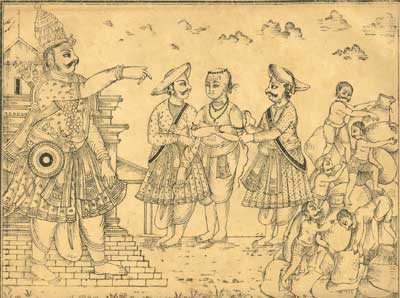
Born in Thiruvadhavur in the 9th Century, as Vadhavooraar, Manickavasagar was minister to King Arimarthana Pandian (Varagunavarman II). The king entrusted him with a large amount of money to buy horses for the army. When the Minister set out on his task, he was met with by Lord Shiva in Thiruperunthurai (Avudaryarkoil) and upon receiving enlightenment, spent all the money on renovating the temple. When the king asked Vadhavoraar to present the horses, he did not know what to do and sought the help of  Lord Shiva who played a divine drama (Thiruvilaiyaadal) and converted all the foxes around Madurai into horses and sent them to the King's stables. At dawn, the foxes turned into their original selves and ran away.

(Photo Courtesy: Adbh266 - Own work, CC BY-SA 4.0)

On hearing this, the king imprisoned Vaadhavooraar. In jail, he rendered several hymns that would melt even the heartless, in praise of the Lord. Finally, the Lord made the King realise the truth. Freed from prison, Vadhavoorar who had received the title Manickavasagar from the Lord himself, for each of his verses was like a precious gem,set out on a pilgrimage, visiting several shrines, before coming to Adi Annamalai in Tiruvannamalai.

Adi Annamalai is known by other names such as Aadhi Annamalai (as sung by Arunagirinathar in his Thirupugazh - Aadhi Arunachalam Amarndha Perumaane and Ani Annamalai, a jewel decorating the foothills of Annamalai. The deity here is believed to have been installed by Lord Brahma. 

Lord Brahma and Adi Annamalai

Brahma and Thilothama
When Brahma created Thilothama, a celestial being, with the finest particles of heaven, earth and the underworld (another version says Brahma asked Vishwakarma to create her) he was smitten by her beauty. Faces evolved in all directions of his head just to see her, as she circumambulated him after being created. Overcome by lust, Brahma asked Thilothama to be his. However, she was shocked, as by virtue of creating her, he was her father. She started running away in fear. With Maya shrouding his intellect, Brahma took the form of a male deer and started following her. 

When she could run no longer, Tilothama took the form a female pigeon and started flying towards Thiruvannamalai, where the Lord had risen in the form of a pillar of light when Brahma and Vishnu were unable to find his feet and tresses. Brahma also took the form of a male pigeon and tried to catch up with her. On Tilothama entering the holy land of Thiruvannamalai, that provides mukthi to those who merely think of it, Lord Shiva took the form of a hunter, and shot down the male pigeon . Brahma was brought out of Maya as soon as his body touched the holy ground. He realised with shame, the foolishness and impropriety of his behaviour and was very repentent. He sought the forgiveness of Thilothama. In order to atone his sins, he installed a Shivalingam on the foothills of Annamalai, to the West of the main shrine, at the spot where he had been relieved of Maya. He created a Brahma theertham next to it and a tank known even today as Ayyankulam (Ayan is another name of Brahma).

Brahma Theertham, now known as Manickavasagar Theertham

It was on the banks of the Ayyankulam that Ramana Maharishi reached on arriving at Thiruvannamalai. He bathed in its holy waters and when he stepped out, he knew his calling. It was the time to renounce all that he had. He threw away the food he had carried from home, and discarded his clothes, but for a piece of dhoti to be worn as a loin-cloth. On seeing this, a barber asked if he wanted his head to e tonsured . He gave up his hair and was ready for his sadhana. A shrine for Arunagirinathar is also found on the banks of this tank.

Ayyankulam Tank

On arriving at Adi Annamalai, Manickavasagar set himself up a few metres from the temple, bathed in the Brahma Theertham which came to be known as the Manickavasagar Theertham and worshipped the Kuzhumani Vinayakar and the Lord every day. The 8th Century Thirupaavai has thirty hymns of Andal calling out her friends to wake up, bathe, observe the paavai nombu and serve/worship the Lord.

Kuzhumani Vinayakar worshipped by Saint Manickavasagar

Manickavasagar, sang twenty songs grouped together as the Thiruvempaavai, in the month of Margazhi urging the young girls to bathe in the Brahma Theertham and serve the Lord of Adi Annamalai. This along with the ten songs of Thirupalliezhuchi make up the Thiruvempaavai. All verses end with the word "Empaavaai", giving it its name. Pleased with his devotion, Lord Shiva appeared before Manickavasagar. The Manickavasagar Matam (Mutt) stands at the place where this happened. 

Manickavasagar Mutt (Photo Courtesy: arunachala-live.com)

This Margazhi, let us attempt to read and enjoy the essence of Thirupaavai and Thiruvempaavai.


Sunday, July 1, 2018

Dakshina Bhadrachalam

Dakshina Bhadrachalam Sri Kothandarama Temple, West Mambalam
Vankayala Kuppaiah Chetty was restless. His health was failing and he could not comprehend why. Especially that night, he felt as if he was swinging between life and death. It was as if a load was placed over his chest, making it extremely difficult to breathe. "Rama, why am I going through such an ordeal?" he asked his favourite deity. 

For years, he had spent hours in the divine company of Lord Pattabhirama, whom he felt was the guiding source of his life. The Lord was in a small, dilapidating shrine. But his glory, grace and presence were in no way small. 

Adi Narayana Dasa, a descendant of Kancherla Gopanna, popularly known as Bhadrachalam Ramadasu, had installed Lord Rama in a small shrine in Mambalam village in the 19th century. The deity was similar to that of Bhadrachalam. Lord Rama in a pattabhisheka kolam, with Sita Devi on his lap, Lakshmana holding an umbrella to the divine couple, and Hanuman holding Rama's foot. He stayed nearby and worshipped Lord Rama with devotion. Every year, he celebrated Rama Navami, with great pomp and glory.  Over the years, the small temple popularly called Dakshina Bhadrachalam, became dilapidated, desperately needing repairs and renovation. However, the grace of the Lord, continued to draw ardent devotees such as Vankayala Kuppaiah Chetty.

The Kothandaramar Temple, West Mambalam
By now, Kuppaiah Chetty was sweating profusely. He called out to his wife, Andalamma to bring him some water. However, the liquid did not go beyond his throat. It was as if his body was on fire. His wife gently fanned him, as he slipped into semi-consciousness. It was then, that the room was filled with a bright, dazzling light. Kuppaiah Chetty felt he was being transported from his body to stand up straight and peer into the divine light. Lord Rama, his divine companion,stood before him as Kothandarama. His compassionate gaze enveloped Kuppaiah Chetty who burst into tears. He was able to see that he was being slow poisoned by his relatives, who were desirous of usurping the vast properties of the childless couple. The divine gaze seemed to penetrate into the body of Kuppaiah Chetty and remove all the toxins that the poison had created. Just as the light entered the room, it reduced into a spot and disappeared. Kuppaiah Chetty was now breathing normally, and slipped into deep sleep.

A painting depicting how Lord Pattibhirama and Kothandarama are found in the sanctum
Next morning, when he woke, he was feeling fit as a fiddle. It was as if all his ailments over the past few months had disappeared into dewdrops in the sun. He recalled how the Lord had revealed what happened and cured him of his ailment. He ran to the temple to offer thanks to Lord Pattabhirama. As he entered the temple, he saw Denuvagupta Venkatrangayya Haridasar, the manager of the temple sitting with a worried expression. But Kuppaiah Chetty was more eager to seethe Lord and thank him for his mercy. After worshipping him, he came out of the shrine. Now, he was able to see Haridasar better. The worry in his face, drew him towards him. Haridasar started sharing his worry - he had Rs.5000 in hand - Rs.1000 from sale of old things at the temple, and Rs.4000 from donations. But that was hardly enough to renovate the beautiful, yet languishing temple. 

Kuppaiah Chetty knew why the Lord had given him a rebirth. His mission was to renovate the beautiful temple built by Adi Narayana Dasa as Dakshina Bhadrachalam. The mission began on that day in 1926 and within a year, the temple was renovated beautifully. He added another Moolavar, Sri Kothandaramar, as he had appeared before him, as well as Lord Ranganatha, who has installed by the side of the sanctum. After that, the temple came to be known as Kothandaramar temple.


A house in the Mambalam Agraharam
Today, the temple stands in pristine condition in what was originally the agraharam of Mambalam village, remainders of which can still be found around the temple. The house in which Adi Narayana Dasa lived and performed Rama Navami, Harikatha and Bhajans, still stands close to the temple, and the urchava murthis worshipped by him are being worshipped till date.

Hanumad Theertham
The temple tank known as Hanumad Theertham was installed in January 1909 by Tummala Penta Narayana Chetty and his wife Kamakshamma. An inscription to that effect is found on the banks of the tank, with a beautiful Sanskrit verse written in Telugu which mentions the creation of a water body as the holiest among dhaanams (grants). 

Inscription at the Hanumad Theertham
The main deity Pattabhirama as well as the Kothandarama installed by Vankayala Kuppaiah Chetty, are flanked on either side by Sri Ranganatha and Sri Yoga Narasimha. So in one row, one gets to worship the Lord in Kidanthan, Ninran and Irundhan postures.

The goddess Ranganayaki Thaayar and Andal are found in seperate shrines. Across the courtyard, facing Sri Rama is Sanjeevi Parvatha Anjaneya Swamy. A very unique Hanuman with the Sanjeevi Parvatha in his right hand, and his left hand showing Abhaya Hastha, he stands facing North (Kubera Moolai). Devotees throng his shrine to worship him and have their genuine prayers answered.

Sanjeevi Parvatha Hanuman (Photo Courtesy: Sri Kothandaramar Temple)
The vasantha mandapam has also been renovated where the Vasanthotsavam happens every year. An inscription describing the temple as Dakshina Bhadrachalam is found in the Vasantha Mandapam.

The Mahamandapam pillars have images of both Vankayala Kuppaiah Chetty and his wife Andalamma. Peepal tree is the Sthala Vriksham of the temple and the poojas are carried out as per the Vaikhanasa Agama. 

Shri Vankayala Kuppaiah Chetty 
       
                              Andalamma
Every month, is a festival month at this temple. Brahmotsavam is celebrated with great glory for ten days in the tamil month of Chithirai, followed by the Vasanthotsavam in Vaikasi, Jyeshtabhishekam and Garuda Sevai in Aani, Gajendra Moksham in Aadi - this is a must watch, when the entire Gajendra Moksham episode is recreated for the benefit of the devotees, Aadi pooram and Andal Kalyanam are also conducted in this month, Krishna Jayanthi in Aavani, Pavithrotsavam in Purattasi, Ten days Manavala Mamunigal Saatrumarai in Aipasi, Karthigai deepam in Karthigai, Vaikunta Ekadesi and Hanumad Jayanthi in Margazhi, Theppothsavam and Laksha Dheepam in Thai, Masi Magam Garuda Sevai, and Sri Rama Navami and Panguni Uthiram Thirukalyanam in Panguni  are the main festivals apart from numerous other events.


How to reach here: The temple is very close to the Madley Road Subway and the Mambalam Bus stand as well as railway station.

Temple timings: 7-10.30 am in the morning, 5-8.30 pm in the evening.

Monday, June 4, 2018

Thiruvananthapuram of Tamil Nadu!

Inside the Aavarani Anantha Narayana Temple
Thousands throng the temple of Lord Ananthapadmanabha Swamy, at Thiruvananthapuram, despite strict security and dress regulations to worship the 18 feet Lord, reclining on a five headed Anantha (Adhisesha) witnessed through three entrances, whereby his Thirumukam (face), Thiruvudal (Body) and Thirupadam (feet) are visible.

Come to lesser known Aavarani, in Nagapattinam district of Tamil Nadu, where Lord Vishnu is seen as Anantha Narayana, also known as Aabharanadhari, his gigantic 21 feet form reclining on a seven- headed Anantha. This Lord, even larger than Ananthapadmanabhaswamy can also only be viewed through three entrances through which his Thirumukham, Nabhi (navel with Brahma rising from it) and Thirupaadham are visible. The only difference here, is that this temple is relatively unknown and one can spend minutes or even hours before the Lord, without any disruption.


Legend 

The Lord Aabharanadhari reclining on the seven hooded Adisesha

The village Aavarani, was originally named Aabharanadhari after the Lord. It is an extension of Thirukkannangudi, one of the 108 Divya Desams. It is believed that Lord Rama on his return to Ayodhya from Sri Lanka, passed through here and on the request of Brigu Maharishi and Veda Vyasa rested here in the form of Mahavishnu. 

The legend of this temple is associated with the life and times of Thirumangai Alwar. According to the Sthala Puranam,  the Alwar, desirous of raising resources for the Srirangam temple, came to Nagapattinam to steal the Golden idol of Buddha at the Vihara . He collected some banana stems from a place called Vazhakarai, stole the Golden idol, hid it among the banana stems during the day, and travelled over night towards Srirangam. The place where he hid the statue during day has come to be known as Porulvaithacheri (now called Poravacheri near Sikkal). He then visited Aavarani and worshipped the gigantic Ananthanarayana Perumal. Seeing the huge Lord, he adorned his body with Tulsi garlands which are said to have turned into different jewels. He then called him "Aabharanadhari Narayana". Because of this, the place came to be known as Aabharanadhari. 

From here, he went to the Thirukannangudi Damodhara Narayana Perumal temple and worshipped the Ninraan and Irundhaan (Veetrirundha Perumal) forms of the Lord.  In his mangalasasanam of the Thirukkanangudi temple, the stanza beginning with "Vangama munneer", according to Vaishnavaite scholars, describes the Ananthanarayana Perumal of Aavarani who is reclined on the Anantha ("sangamaarangai thadamalarundhi samameniyen") and hence it is inferred that this sthalam must have been part of the Thirukkannangudi Divya desam originally. Government records also mention Aavarani village as Thirukkannangudi Agaram which reemphasises the fact that Aavarani was a Brahmadeyam (tax free land provided to Brahmin scholars) of Thirukkanangudi.

The Lord

Lord Ananthanarayana at Aavarani
The gigantic form of Lord Ananthanarayana Perumal completely fills the sanctum. Reclining on  seven hooded Adisesha, with a Marakkal (measuring utensil) as headrest,  his head is placed in the Southern direction and feet towards North. He has a right hand supporting his head, and a left hand extended upto his knee.  He wears a number of ornaments on his body true to the name of Aabharanadhari. On his head, he wears a crown, kundalams in his ears, katakas on his arms, a beautiful Nalankilar Haram on his broad chest, sacred thread, and anklets on his feet. Brahma raising from his navel, and Sridevi and Bhudevi found by his side, are also wearing ornaments. Apart from them, Sage Bhrigu and Veda Vyasa are found at the head and foot of the Lord respectively as he gave vision to them at this site. 

Other Deities
Goddess Alankaravalli
On entering the temple, one can see the Pakshiraja Garudalwar facing the Lord. He is seen with snakes as ornaments on his body. He is flanked by a beautiful Hanuman, known as Padma Hanuman. Goddess Alankaravalli is found in a separate shrine . The temple well is very special as the water is said to be extremely sweet. The temple tank is called Ananthapushkarani and bathing here and chanting Achutha, Anantha, Govindha thrice, rids one of all problems and turns them towards liberation.

Inscriptions:

The beautiful well at the Aavarani Temple
A total of eleven inscriptions have been read at this temple. Out of which nine are from the Chola period, one from the Pandya period and another from the Vijayanagara Period. The oldest among them is from the time of Raja Raja Chola II from 1150 AD. This inscription calls Aavarani as Aabharanadari Chaturvedimangalam. The inscription also mentions a Siva temple known as Thiruvirameswaram which probably existed in Aavarani.

There are six inscriptions belonging to the period of Kulothunga Chola III, and one of Jatavarman Kulasekhara Pandyan.  A 1474 AD inscription of Thippayya Devamaharaya refers to the village as Aabharanadhari yaana Uttaranandapuram and the Lord as Pallikonda Perumal.

The rest of the inscriptions talk about temples nearby. One of the inscriptions refer to Simmavishnu Chaturvedimangalam and a deity called Parvatheeswara mudaiyar and about grants given to the temple. This inscription also mentions the villagers of Ranajaya Chaturvedi mangalam giving grants to Parvatheeswara mudaiyar. This probably was another temple near Aavarani.  Another inscription mentions Chitralekha Perumpalli which probably was a Buddha Vihara nearby. There have been exchange of land between the Parvatheeswara mudaiyar temple and the Chitralekha Perumpalli.

Other significance:

Padma Anjaneya at the Aavarani Temple
This temple is one of the Pancha Narayana Kshetrams referred to in the Garuda Puranam as Pancha Badra. The others being the Damodara Narayana Perumal in Thirukannangudi, Yadava Narayana Perumal in Keevalur, Deva Narayana Perumal in Devur and  Varada Narayana Perumal in North Alandhur.

How to reach here:

This temple is found on the Nagapattinam - Thiruvarur route, about four kilometres from the famous Sikkal Murugan temple.  GPS Coordinates : (10.74561792, 79.77533913)

Contact: S Kumar Bhattar - 97885 17247

Temple Timings: 9-11 am, 5-7 pm

Updated on 04 June 2018:

Inspired by the Lord Anantha Narayana, Poet Diwakara Tanujaha (Mr Sudharshanam) has composed a beautiful verse on him which he has also rendered as an audio file for our listening pleasure:

ஆவரணி ஆபரணம்
–--------------------------------

(எண்சீர் விருத்தம் – விளம் காய் மும்முறை இரட்டித்தது)

இடதுகை நீளவல(து) எழுதலை வாங்கக்கைக்
...கடகமும் குண்டலமும் கால்களில் தண்டையுமாய்ப்
படியணைந் தாவரணி படுத்துளான் பார்க்கிலனே!
...பணிலமா ரம்பொலிதோள் பொன்முகம் ஒருவாசல்
படைமல ரன்முகிழ்கொப் பூழ்நலங் கிளராரம்
...பாதுகம் இருவாசல் முப்படக் கிடக்குமணி
நெடுவடி மூவேழாய் நீண்டநல் ஆபரணம்
...நிறைமலர் நகையாக்கி நெகிழ்ந்தவன் காணாமோ?

(கடகம் – கையில் கட்டும் கங்கணம்; படி – தானியங்களை அளக்கும் மரக்கால்; பணிலம் – சங்கு; ஆரம் – சக்கரம்; படைமலரன் – படைக்கும், மலரில் இருக்கும் பிரமன்; கொப்பூழ் – தொப்புள்; நலங்கிளர் ஆரம் – பெருமான் அணிந்திருக்கும் நலங்கிளர் எனப்படும் ஆரம்; பாதுகம் – கால்கள்; நிறைமலர் – நிறைந்த மலர், இங்கு துளசி இதழ்)

பொருள்:
----------------
இடது கையை நீட்டி வைத்து, வலது கையை, உயர்த்திய தலைக்கு முட்டுக் கொடுத்து, கையில் கங்கணமும், காதில் குண்டலமும், கால்களில் தண்டையும் அணிந்துகொண்டு, தானியங்கள் அளக்கும் படியைத் தலைக்கு அணை கொடுத்து, ஆவரணி என்னும் ஊரில் படுத்துக் கொண்டிருப்பவனை நான் இன்னும் பார்க்கவில்லையே!

சங்கும் சக்கரமும் தாங்கிய பொலிகின்ற தோளும், பொன்போல் ஒளிர்கின்ற திருமுகமும் ஒரு வாசல் வழியே, நாம் காணுமாறும், நலங்கிளர் என்னும் ஆரத்தைத் தாங்கும் மார்பையும், படைக்கும் தொழிலைச் செய்கின்ற பிரமன் முளைத்த நாபியையும் நமக்கு இன்னொரு வாசலில் காட்டியபடியும், மூன்றால் வாசலில் தனது பாதங்களைக் காட்டியும், முப்பகுதியாகக் கிடக்கும் மணி அவன்;

நிறைவு பெற்ற மலரான துளசியை, தனக்கு இட்டவரின் பக்தியில் நெகிழ்ந்தவனாய், நீண்ட உருவமாய், இருபத்தொரு அடி நீளத்தில், ஆபரணமாகவே விளங்குகின்ற அவனை நாம் காண வேண்டாமா?

(திருமங்கை ஆழ்வார் இட்ட துளசி மாலை, அவனுக்கு மணிகளாக மாறி அலங்க்கரித்ததால், அவனை ஆபரணதாரி என்றே அழைக்கிறார்கள். மேல் விவரங்களுக்கு வலைப்பூவைப் படிக்கவும்.)

Audio Link to the verse


Tuesday, October 24, 2017

Vayalanallur Kandaswamy!

Kandasamy Murugan at Vayalanallur
This post is two years late. Although I had visited this temple first in 2015, and then several times since, even taking people on heritage trips, I never got around to writing about the Lord who had become one of my favourites. As I have always seen in Aalayam Kanden, everything happens with His will and he has willed that this post be written on the account of Kanda Sashti in 2017 and so here it is. 

Two years of documenting the temples along the Cooum threw open several rare heritage treasures. One such priceless treasure is the Murugan temple at Vayalanallur. The Topographical List of Inscriptions of Madras Presidency Volume 8 by T V Mahalingam was one of my guiding documents for my study and it spoke about three temples in Vayalanallur, one of which was a Kandaswamy Murugan temple, the second a Durga temple and the third, the Shakthimutreswarar temple.

The current status of the Kandasamy Murugan Temple with the Aditya I inscription luckily intact
Our search of the temples led us first to the Komaleeswaranpet temple, at Kolappanchery. We met Nagahariharan, the priest at Kolappanchery who incidentally mentioned that he was the priest at the Vayalanallur Murugan temple and offered to take us there. He has been conducting the poojas as a volunteer for some years now, purely because his Kuladeivam (family deity) is Murugan.

We were touched by his commitment and followed his two-wheeler into a narrow lane. What would have once been a huge temple, has now been reduced to a single shrine. " Nobody comes to the temple, except on important festival days such as Panguni Uthiram or Thai Poosam where we somehow collect enough money to offer food and prasadams to attract a decent gathering,"said Hari as he opened the door of the temple.

We were awestruck by what we saw. By far, the most magnificent of the Brahma Sasthas that we have seen in that region, stood before us on the floor. Over seven feet tall, with an Akshara Mala in his hind right arm and a Gendi on the left, he stood with a smile turning up the corner of his lips.  There was no pedestal below his feet, no garlands around his neck nor any adornments. Just a humble vastram was all that he had.

The magnificent Murugan at Vayalanallur
Hari offered the prasadam he had carried from his house and performed Harathi. We were moved. All that remained of the antiquity of the temple, was the inscription from the time of Aditya I  (895 AD) about a gift of land made to the temple by Gunakirti Nambadugan, the Kilan of Ayandampakkam for Sribali and other services at the temple which is still found on the footsteps of the temple.

A total of four inscriptions were recorded in Annual Report on Indian Epigraphy 1952-53 as follows:

ARE 1952-53 no 226 three fragmentary stones in Murugan temple Aditya I RY 24 - 895 CE, registers gift of land made by Gunakirti Nambadugan the kilan of Ayandampakkam to the village for expenses of Sribali and other services to god.

ARE 1952-53 No 225 - On a slab in compound of same temple Chola Parthivendravarman r.y.5 - 961 CE - Seems to register the gift of tax free land by a native of Ayandampakkam in Pulal Kottam to the God Sattimutrathudeva of Vayinanallur in Puliyur kottam.

ARE 1952-53 - No 228 - On two slabs same place damaged - Parthivendravarman R.y. 8 - 964CE - records a gift of land made tax free. Mentions Pillaipakkam in Mangadu Nadu

ARE 1952-53 No. 227 - On a stone lamp post in the same place - Rajaraja I - seems to commence with the historical introduction - Kandalulr salai. Mentions a vellala of Sirupuliyur and the God of Vayinanallur situated in Puliyur kottam.

The Shakthimutreswara temple next to the huge temple tank had been lost to time. A look at the gigantic deity gave us an idea of how large the temple would have been in yore. The three inscriptions of this temple, two from the time of Parthivendravarman and one from Rajaraja I have disappeared along with the original temple and several deities that stood there. 

The Shakthimutreswara when we saw him first in 2015
When we enquired with Hari about the Durga temple he did not know much as to where it once stood. However, he remembers villagers saying a huge goddess was lowered into a well because it had become damaged! 

Several deities have been found while excavating around the original site of the Shakthimutreswara temple out of which a Bhairavar has been installed in the Vishnu temple and the Surya placed next to the Shakthimutreswara.

With the grace of the Almighty and generous patronage from the loyal supporters of Aalayam Kanden, we have been successfully supporting the Thai poosam festivities at the Kandaswamy Murugan temple over the last two years. 

Supporting the Thai Poosam festivities through the Aalayam Kanden Trust
The Shakthimutreswara temple has since been rebuilt in a small way, and the deity has found a secure place inside the sanctum.

The Kandaswamy Murugan has since became a member of the Aalayam Kanden family and he was gracious enough to bless the first copy of "The Gods of the Holy Koovam" which was the compendium of ancient sites along the Koovam. 

The Kandaswamy Murugan with the first copy of The Gods of the Holy Koovam
The temple still has very little support or patronage. As we celebrate the victory of good over evil on this Kanda Sashti, let us do our bit to protect and patronise the rare heritage treasures still left among our midst!
Kandasamy Murugan in all his glory after Thai Poosam alankaram
How to reach here: The temple is about 2 kms from Kolappanchery. From Kolappanchery head North. Pass Chokkanallur bus stand and turn right. The temple is on the left. Bus route 54C from Poonamallee to Thandarai is available once an hour. GPS Coordinates : 13.08565622, 80.06954102

Temple Timings: Please inform the Gurukkal before going and he will ensure the temple is opened.

Contact Information: Naagahariharan 90031 54640


Saturday, April 8, 2017

Know your Nayanmars - Part II (The Kings)


Ten Kings have been named by Sundaramurthy Nayanar as Nayanmars. This works out to 1/6th of the total number. These Kings ruled the land as representatives of the Lord, putting service to Him and his devotees, above everything else! The list below describes the life and devotion of these kings. The number allocated shows the order in which they were named by Sundaramurthy Nayanar in his Thiruthondathogai!

4.  Meiporul Nayanar
Birth &  Mukthi -  Tirukovilur 
Guru poojai – Karthigai Uthiram 
Temple - Tirukovilur Veeratam


Meiporul Nayanar was the King of Chedi Nadu and ruled from Tirukovilur. He was a staunch devotee of Lord Shiva and would treat all his devotees with great respect. Another King Muththinathan, had tried to win Meiporul Nayanar at war but had not been successful. After several attempts, he decided to take the route of deceit. Disguising himself as a devotee, he reached the palace of Meiporal late one night. The King’s personal bodyguard, Thathan stopped him, telling him the King was asleep. Muththinathan said that he wanted to meet him urgently. The Queen, on seeing the visitor, woke the king up. The King welcomed the visitor, and asked him what he wanted. The latter mentioned that he had brought a rare agama from the Himalayas and wished to discuss it with the King alone. Trusting him, the King asked his queen to go away. Once they were alone, Muththinathan took out the dagger hidden inside the book, and stabbed the King. As he fell, Thathan rushed inside. He drew his sword to kill the enemy. However, Meiporul Nayanar forebade him, as he was in the guise of a devotee and asked him to be escorted till the borders, so that no one would harm him. Such was the King’s devotion towards the Lord and his devotees!


36. Kazharitratrarivar Nayanar (Cheraman Peruman)
Birth & Mukthi – Kodungallur
Guru poojai – Aadi Swathi
Temple – Mahadevar Temple, Thiruvanjaikalam
Cheraman Peruman and Sundaramurthy Nayanar at the Thiruvanjaikalam Temple


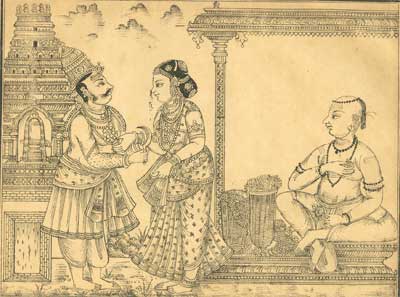
Perumakkothaiyar was born in the royal family of Cheras but instead of taking up the throne, he spent his time in the worship of Lord Shiva. One day, the King Chenkorporaiyan gave up his throne to lead an austere life. So the ministers approached Perumakkothaiyar to accept the throne. He thought it would be a hindrance to his worship and sought guidance from the Lord. The Lord blessed him with the knowledge to know what others think and hence he came to be known as Kazharitrutrarivar. After his coronation as Cheraman Peruman, he was riding on his royal elephant, when he saw a washerman returning home. The wet sand from the river had dried on his body and it gave an appearance like holy ash smeared all over. To Cheraman Peruman, he appeared like a devotee of Shiva. So he jumped down from the elephant, and bowed before the washerman. Shocked, the washerman fell at the feet of the King, saying I, am your slave, a washerman for which the king responded I, your slave, am a Chera. Cheraman Peruman was a great devotee of Lord Nataraja. The Lord accepted the prayers by sounding the bells on his feet every day. In Madurai, there was a poet named Banabathirar. He was wallowed in poverty. So, Lord Shiva told him to take a message from him to Cheraman Peruman in return for which he would receive rich gifts. Banabathirar took the message to Cheraman who danced with ecstasy on seeing the message from the Lord himself. With tears of joy, he ordered for all the riches in the palace to be brought out for Banabathirar to take. He offered those along with the elephants, horses and the throne itself. The poet was taken aback at his generosity. He only chose those things he wanted, and humbly returned the rest to the King.

One day when Cheraman finished his prayers, he did not hear the sound of bells. He was hurt and upset that the Lord was not happy with his prayers. So he pulled out his sword and tried to kill himself. On seeing this, the Lord hurriedly sounded the bells on his feet. When Cheraman enquired the reason for delay, the Lord said that he had been distracted due to the sweetness and devotion in the song of Sundaramurthy Nayanar. On hearing this, Cheraman wanted to meet Sundaramurthy Nayanar. He met Sundarar at Tiruvarur and both divine souls embraced each other. They went around temples, singing hymns. Cheraman invited Sundarar to visit Kodungallur, which the latter accepted. The King placed him on the royal elephant, and fanned him and when he reached the palace, he put him on the throne and washed his feet. Sundarar on his second visit, sang to the Lord of Vanchaikalam that he wanted to attain his lotus feet. So the Lord, sent a white elephant to escort Sundarar to Kailash. On hearing this, Cheraman got onto his horse, and whispered the Panchakshara. The horse climbed up into the sky and caught up with Sundarar’s elephant. They reach Kailash where Sundarar was allowed entry but Cheraman Peruman was not. Sundarar explained to the Lord that Cheraman had come out of love for the divine almighty. He was then allowed entry and he sang the Thirukailaaya Gnana Ula. This was heard by Maasathanar (Ayyanar) who revealed it to the world at Thirupidavur.

For a complete article on the Thiruvanjaikalam temple on Aalayam Kanden, click here

38. Kootruva Nayanar

Birth & Mukthi – Kalappaal
Guru poojai – Adi Thiruvadhirai
Temple – Adhiteshwarar Temple, Kalappaal

Kootruva Nayanar was a devout Shaivaite who spent hours lingering in the thoughts and service of Lord Shiva. He was a chieftain of a small area. Over time, he acquired different battalions and expanded his territory, by winning over enemies. He approached the Dikshithars of Thillai to crown him as King. They refused saying they would only do it for the Chola Kings. Disappointed, Kootruva Nayanar wept in front of the Lord of Thillai asking him to place his lotus feet on his head as crown. Delighted with his devotion, the Lord placed his feet on his head that night which was his crown for the rest of his life.

39. Pugazh Chola Nayanar
Birth – Uraiyur Mukthi – Karuvur
Guru poojai – Adi Karthigai
Temple – Panchavarneswarar Temple, Uraiyur


Pugazh Cholar was the great devotee who had asked Eripaththa Nayanar to kill him when his royal elephant had scattered the flowers meant for the Lord’s worship. He once went to Karuvur, to collect the taxes payable by the Kings of Kongu and Kudagu. There he asked his ministers if there was any one who was unwilling to pay, The ministers reported that Adhigan had not paid yet. Angered, Pugazh Cholar ordered his forces to attack Adhigan’s kingdom. Adigan was no match to the Chola army and he soon ran away into the forest. The soldiers collected gems, jewels, money and horses of Adhigan and also took the heads of those killed as souvenirs. When Pugazh Cholar came to inspect the heads, he found there was one among them of a devotee of Lord Shiva. Feeling he had sinned in killing a devotee of Shiva, Pugazh Cholar held the head of the devotee in a plate above his head, and entered the fire.

40. Narasinga Munaiyaraya Nayanar

Birth & Mukthi – Thirunavalur
Guru poojai – Purataasi Sadhayam
Temple – Bhakthajaneswarar Temple, Thirunavalur
Narasinga Munaiyaraiyar with Sundarar's parents in Thirunavalur
Narasinga Munaiyarayar was the King of Thirumunaipadi. He was a staunch Shaivaite and gave several grants to conduct daily worship in temples. On every Tiruvadhirai day, he would provide food and a hundred gold coins to the devotees of the Lord. Once when he was doing so, a man ailing with leprosy, came wearing the Holy Ash. While the others turned their face with aversion, Narasinga Munaiyaraiyar welcomed him warmly, treated him with respect and offered him food and twice the quantity of gold. Such was his love for the devotees of God!

For a complete article on the Bhakthajaneswara temple at Thirunavalur on Aalayam Kanden, click here

45. Aiyadigal Kadavarkon Nayanar
Birth – Thirukachiyegambam  Mukthi – Kanchipuram
Guru poojai – Aipasi Moolam
Temple – Ekambareswarar Temple, Kanchipuram

Aiyadigal Kadavarkon was a Pallava ruler (believed to be Simhavarman - 550 to 575 CE) who ruled from Kanchipuram. After ruling over his subjects fairly and peacefully, he decided to spend the rest of his life in the worship of the Lord. So he crowned his son as the King, and set travel to different temples of the Lord, worshipping him and offering his services till he reached the lotus feet of the Lord. The hymns rendered by him on twenty four temples have been found and are called Kshetra Thiruvenba. They have been classified under the 11th Thirumurai. 

48. Ninra Seer Nedumara Nayanar
Birth & Mukthi – Madurai
Guru poojai – Aipasi Bharani
Temple – Meenakshi Amman Temple, Madurai

Nedumaran was the Pandya King. He was a Jain and hence did not encourage Shaivaite worship. His wife Mangayarkarasiyar and minister Kulachiraiyar, requested Thirugnanasambandar to come to Madurai and provide wisdom about Shaivism to him. The king was called Koon pandiyan because he had a hunch. Gnanasambandar, cured him of his stomach ulcer and through the grace of the Lord, he also got rid of his hunch, and came to be called Ninra Seer Nedumaran. The King became a staunch Shaivaite and spread the glory of the Lord for many years, before gaining a place in His abode.

51. Kazharchinga Nayanar
Birth – Thirukachchi Ekambam
Guru poojai – Vaikasi Bharani
Temple – Ekambareswarar Temple, Kanchipuram


Kazharchinga Nayanar was a Pallava King. Desirous of worshipping the Lord at Tiruvarur, he set off with his wife. The King was joyous of seeing the Lord, and spent several minutes in meditation. The queen in the meantime, wandered around the temple. There were baskets of sweetly smelling flowers being tied into garlands. Seeing a flower fallen off the dais, she picked it up and smelled it. Cheruthunai Nayanar, who saw the queen smelling a flower intended for the worship of the Lord, immediately pulled off his sword and cut her nose. The queen rolled on the floor, in pain. On hearing her wails, Kazharchingar came looking for her and when he saw her,  roared in anger, as to who had the audacity to perform such an act. When Cheruthunai Nayanar explained what had happened, Kazharchingar was furious. He said that the punishment given was not adequate and chopped off the hand that smelled the flower too. There was a rain of flowers from heaven, in praise of his act. 

52. Idankazhi Nayanar
Birth & Mukthi – Kodumbalur
Guru poojai – Aipasi Karthigai
Temple – Mukundeeswarar Temple, Kodumbalur

Idankazhi Nayanar was the King of Konadu. Once, a devotee who was in the habit of feeding other devotees every day, stole grain from the King’s storage. The soldiers caught him and produced him before the King. When he came to know that the devotee had stolen grain, only to feed the devotees of Shiva, the King immediately set him free, asking him to take as much grain as he wanted. He also made an announcement that the devotees of Lord Shiva could take as much grain as they wanted from the King’s storage at any time.

59. Kochengatchola Nayanar
Birth – Thiruvaanaikka Mukthi – Chidambaram
Guru poojai – Masi Sadhayam
Temple – Jambukeswarar Temple, Thiruvanaikka
Thirumarugal - one of the Madakovils built by Kochengatcholan
A white elephant was worshipping the Lord manifested under a white Jamun tree near Chandra Theertham in Chola country. Because of this, the place came to be called Thiruvanaikka. A spider that resided on the tree above, spun a web over the head of the Lord, protecting him from falling leaves. When the elephant brought water to bathe the Lord, it found the spider’s web and thinking of it to be unholy, broke it with its trunk. The spider was upset and built a web again. The next day, the elephant broke the web again. This time, the spider wanted to teach the elephant a lesson. It got into its trunk and started biting hard. The elephant could not remove the spider and unable to bear the pain, it beat its trunk on the ground, and died. In the process, the spider also lost its life.

Subadevan, was a Chola king. He and his wife Kamalavathy longed for a child, and prayed to Lord Shiva. With his grace, Kamalavathy soon conceived and when she went into labour, an astrologer predicted that if the child was delivered an hour later, he would grow up to be a great king. So Kamalavathy asked her maids to tie her upside down so that the child birth was delayed. When the child was born, his eyes were blood shot. Kamalavathy called out to her child as “En Sengannano!” before breathing her last. This child was none other than the spider that had died inside the trunk of the elephant. Chengatcholan became a great King as prophesied, and served God with the thoughts of his previous birth. He built a huge temple for Lord Shiva at Thiruvanaikka and several other temples as Madakovils – temples that cannot be climbed by elephants. He then went to Chidambaram where he built houses for the Dikshitars and spent the remainder of his life, in His holy presence.

Check out other posts about the Nayanmars on Aalayam Kanden:

The Ladies : http://aalayamkanden.blogspot.in/2017/04/know-your-nayanmars-part-i-ladies.html

The Warriors: http://aalayamkanden.blogspot.in/2017/04/know-your-nayanmars-part-iii-warriors.html
For a free download of an e-book on the lives of the Nayamars, click here: