Showing posts with label Salem Temples. Show all posts

Monday, May 28, 2018

Dattagiri Guhalayam

Dattagiri Murugan Temple
Kongu region in Tamil Nadu is well known for its Murugan temples. As the Tamil porverb goes " Kunrirukkum Idamellam Kumaran Iruppan", every hillock in this region has temples where Lord Muruga is found in all his glory. One among them is the temple at Dattagiri.

The hillock found on the Namakkal - Sendhamangalam road known as Sanyasikundru, has come to be known as Dattagiri. There are two temples found on this hillock - one is a temple for Lord Muruga, known as Guhalayam and the other, a temple for Dattatreya, giving the hillock its new name. Both temples are being maintained by the Sri Shantananda Swamigal Sathsangam.

The Dattagiri Guhalayam seen on top of the Hillock
The Guhalayam is most sought after by those longing for the gift of child birth. Gone are the days when having a child was a routine occurence. Today, technology, poor lifestyle and delayed marriages are causing fertility issues in a number of couples, who seek divine intervention along with modern medicines to bring forth a baby into their lives. The Dattagiri Guhalayam has couples from different parts of world coming here with prayers of child birth. 

Procedure for worship:

Procedure for worship at the Vijayaraja Vinayaka and Kasi Viswanathar shrines
Those couples praying for child birth carry water in their own hands and perform abhishekam to Vijayaraja Vinayaka and Kasi Viswanatha found midway while climbing the hillock. They can also perform abhishekam with milk or sandal paste. Worship is permitted in these shrines from sunrise to sunset only (6 am - 6 pm). Not more than five minutes is permitted per couple to ensure everyone who has travelled far gets a fair and equal chance to perform pooja here. The couple chant Sivaya Nama 108 times while performing the abhishekam. They then begin the ascent towards the Guhalayam. Right from the foothills till such time the prayers are completed, they are expected to maintain silence, focusing on the supreme power and sincere prayers for their desire to be fulfilled.

Shri Swayamprakasa Brahmendra Saraswatavadootha Mahaswami
After climbing fifty steps, they first worship at the Dattatreya shrine. This shrine is found in two levels, the shrine for Dattatreya, son of Sage Athri and his wife Anusuya on the higher level, with the samathi of his long term devotee and disciple, Shri Swayamprakasa Brahmendra Saraswatavadootha Mahaswami on the lower level below the idol of Lord Dattatreya.

Afer praying here, they reach the Guhalayam and perform milk abhishegam to the beautiful deity. Then then come down from the shrine, and worship Heramba Panchamukha Ganapathy, Panchamukha Hanuman, Dakshinamurthy, Vanadurga and Veerabadra Swamy. Post which they descend the hillock and perform a circumambulation of the hillock and offer their salutations.

Dattagiri Murugan
The Vibhuti (sacred ash) provided at the end of the abhishekam is taken back with them and worn daily with reverence by the couple, to find their prayers answered soon. They then come back with their little one to offer thanks and perform abhishekam to the Lord again. 

Panchamukha Hanuman

As this temple is of recent origin, I had not originally been interested in it. However, after hearing so many instances from friends and family about prayers of child birth being answered here, I decided to visit in order to share the benefits with a larger audience.

Although the temple is new, the serenity and cleanliness of the environment and the very pleasant ambience facilitate divinity. One can see several couples visiting with their little ones, offering words of encouragement and support to those who have come here to pray. Overall, it is a very positive environment, worth visiting.

Heramba Panchamukha Ganapathy


How to reach here: Sanyasikunru or Dattagiri hill as it is called today, is found on the Namakkal- Rasipuram State Highway, about 12 kms from Namakkal.

Temple Timings: Morning - 6 am to 12 pm Evening 5 pm to 7.30 pm

Contact: 91504 11378, 99448 48962


Thursday, November 12, 2015

Koogaimalai Kumara!

Belukurichi Palaniappa Temple
Belukurichi is a small village on a hillock called Koogai malai, on the Kolli range in Namakkal district of Tamil Nadu. The Kolli hills are in the Southern part of the Eastern Ghats, yet untouched by commercial tourism which has helped them retain their surreal beauty. The hills find mention in epics like Silapathikaram, Manimekalai, Purananooru and Ainkurunooru. The village had been originally named after Lord Muruga (who is called Palani Appa now) as Velavan Kurichi.

The Palani Appa temple is unique in several aspects. One would have seen Lord Muruga depicted in various forms in different temples - such as Baladhandayuthapani, Gnana Skanda, Brahma Sastha, Subrahmanya, Arumuga, Valli Devasena Pathi, Jayanthi Nathan etc. but Lord Palani Appa of Belukurichi is different from any of these forms.

Why did he come to be known as Palani Appa? Bhogar, one of the eighteen Siddhars had the ability of making statues from an elixir of nine poisonous materials, commonly known as Navapashanam. Water used to bathe these idols when administered to patients, could cure chronic ailments. The famous navapashana statue made by him is in Palani hills. The deity here in Belukurichi is said to have been created by Bhogar much ahead of the one in Palani, from the Pashanams of Kolli hills and hence the Lord is called Palani Appa ( the one that came before Palani).
A view of the Kolli Hills from atop the Belukurichi temple
The Lord facing West is found here in the guise of a hunter. His hair is pulled into a knot on the right side of his head and a string of Konrai flowers (Golden shower) are found etched around it.

Three lines of sacred ash with a spear (Vel) in the middle are found on the forehead of the deity. This symbolises a union of Shiva and Shakthi. A string of golden shower flowers are also found tied around his waist, from where hangs a dagger! He is seen with a Vajravel in his right hand, and a rooster in his left, wearing footwear!
The enchanting Palani Appa of Belukurichi!
Usually, when deities are depicted holding weapons, the height of the weapon does not exceed the height of the deity. However, here we find that the spear is shown taller than the deity. Lord Shiva, Vishnu and Brahma have bestowed their powers to the Lord through the spear, which is depicting having three parts denoting each of them. Due to this, the spear is shown taller than the deity himself.

On full moon days, thousands of people gather here to witness the midnight worship. It is believed that the eighteen Siddhars come here to worship him at that time. The abhishekam and alankarams are all completed by 11.50 pm and the doors of the sanctum are closed and all the devotees move outside to wait. At the stroke of midnight, the doors are opened. Signs of puja having been performed, and visible signs of changes in the alankaram are witnessed to this day.

Once the abhishekam is complete, sweat emanates from the deity's tip of the nose, chin and chest with three different fragrances!


A Shiva lingam has been etched above the entrance of the sanctum. On the ceiling of the Artha Mandapa, two snakes have been depicted swallowing the Sun and the Moon.  Meditating on the Lord, sitting on a green stone right under these snakes, is said to answer genuine prayers.

The Tiruchengode hill where Lord Shiva and Parvathi are found as Ardhanareeswara can be seen at eye level from the head of the peacock found in the Maha Mandapa. It seems as though Shiva and Shakthi are watching over the son who has been created with both their features, right from their abode.

The temple is said to have been built originally by Valvil Ori, who ruled this region around 200 CE. He was one of the seven philanthropists mentioned in Sanga Literature. Tales of his valour are being sung as part of folk lore even today. A statue of Valvil Ori is found at the entrance of the temple complex. Poet Avvaiyaar has also worshipped the deity here.

Kanda Shasti festival which begins today is celebrated with great festivity apart from Thai poosam, Panguni Uthram and Krithigai .

Other deities at Belukurichi
There are shrines for Ganesha, Goddess Kumarinayaki, Vishnu, Krishna, Nagas and Shani.

If you want to spend some quiet time, in the serene company of an enchanting deity, in the ethereal beauty of the Kolli hills, this is your destination.

How to get here:

Belukurichi is about 25 kilometres from Namakkal. On the Namakkal - Tiruchengodu route, Belukurichi is about 13 kms from Sendamangalam.

Temple Timings:

The temple is open from 8 am to 5 pm.

On full moon days, the temple is open from 8 am in the morning till 5 am the next morning.

Contact:  95244 49931


Saturday, October 5, 2013

Kalyana Avvaiyaar!

Sri Karapuranathar Temple Uththamacholapuram
There are a number of special temples for marriage prayers such as Thirumananjeri, Thiruvidanthai and Mudichur. But this temple in Salem District also famous for marriage is unique because here the prayers are placed before the tamil poet Avvaiyaar!

Kalyana Avvaiyaar!
Which temple is this? Why did it become significant for marriage prayers? Let us go back in time to find out!
Welcome to the Karapuranathar temple, Uthamacholapuram.

Karapuranathar:

It is believed that Khara and Dushana, the brothers of Ravana performed penance here to get a vision of Lord Shiva. After many years when the lord did not appear, the brothers decided there was no point in living further and decided to burn themselves to death. As they lit the fire and were about to jump into it, Lord Shiva appeared before them. Kara worshipped him with joy and built a temple around the Swayambu moorthy and the place came to be known as Karapuram and the lord Karapuranathar.

A little boy called Gunaseelan once wanted to worship the Lord but the Lingam was too tall for him. After several attempts to garland the Lord, the boy was disheartened and started to weep loudly. Just at that moment a miracle happened! The Lord lowered his head to one side to allow the little boy to garland him. The boy was overjoyed and completed his worship with satisfaction. Even today, the Lord is found with his head tilted to one side and hence is also called "Mudisaithanathar".

Karapuranathar - The Lingam tilted to one side.
Marriage of Angavai & Sangavai:

Vel paari, one of the "Seven greatest bestowers" of the last Sangam Era had two daughters Angavai and Sangavai. The Chera, Chola and Pandya kings in their desire to expand their territory, lay siege on the territories of King Paari. After a long drawn war, Paari was killed treacherously. His death left the two girls orphaned and Poet Kabilar, a bosom friend of the King took them under his care. He approached several Velir kings to accept the girls as brides for their sons, but they refused, fearing the wrath of the Moovendar (Chera, Chola & Pandya). Kabilar handed over the girls to a brahmin in Thirukoilur and fasted to death. The place where he fasted to death is called Kabilar Kundru and can be seen till date in Thirukoilur. The brahmin thought the only person who could solve this problem and get the girls married was Poet Avvaiyaar and brought the girls to her.


Avvaiyaar approached Deiveegan and Yenadhi Kannan, the sons of Malayaman Thirumudi Kaari to marry Angavai and Sangavai. The young princes agreed to marry the girls provided the Moovendhars did not have an objection. Avvaiyaar came to Karapuram and worshipped Lord Ganesha and asked him to assist in convincing the Moovendhar. Lord Ganesha who is found in the name of "Vinai Theertha Vinayagar " in this temple wrote the marriage invitation on a palm leaf and invited the kings. The Moovendhars promised to provide consent if Avvaiyaar was able to make fresh leaves sprout from a dried palm tree at the temple. Avvaiyaar sang hyms in praise of Lord Karapuranathar and with his grace, the tree bore not just new leaves but also fruits.

The Moovendars happily consented to the wedding and Kanjamalai Karadi Siddhar who worshipped Karapuranathar in the form of a bear was the witness to this agreement. The Jeeva Samadhi of Karadi Siddhar is found in this temple.
The Jeeva Samadhi of Karadi Siddhar
Marriage Prayer at the temple:

Boys and Girls seeking good marriage alliance come to this temple with three garlands - One for Lord Karapuranathar, One for Goddess Perianayagi and the third for Avvaiyaar, preferably on the date their birth star occurs during the month. After performing archana to the God and Goddess, the garland that adorned the Lord in case of a girl and the Goddess in case of a boy is given to them. They wear the garland and go around the temple carrying coconut, flowers and a garland for Avvaiyaar. They garland Avvaiyaar,break the coconut and make sincere prayers for an early marriage. Soon the alliance is fixed, and they come back to offer new saree and the first invitation to Avvaiyaar.

Several marriages thus fixed also take place in this temple. Many love marriages happen here, as this is the temple where Angavai and Sangavai had overcome several obstacles to find a good groom. The temple actually has a notice board which gives the list of documents that are required to register a marriage!


Avani Moolam Festival:

One of the 64 divine acts (Thiruvilaiyadal) of Lord Shiva was carrying mud on behalf of an old lady called Vanthi who offered him Puttu ( a sweet rice dish) in return. This Avani Moolam festival is enacted on the banks of Manimuthaaru River every year. It is believed that the Pandya king took pearls from the Manimuthaaru and used it to garland Goddess Meenakshi of Madurai and these pearls still adorn the Goddess's neck. There is an idol of Vanthi in the Artha Mandapam at the temple.The symbols of Chera, Chola and Pandyas are also found here.


How to reach here:

The temple is on the Salem - Sangagiri Main Road near Ariyaanur.

Temple Timings:
7.30 am - 12.30 pm in the morning
4.30 pm - 7.30 pm in the evening

Contact Details:

S. Anandhan Gurukkal - 97887 18970

Goddess Periyanayagi


Sunday, June 24, 2012

World's largest Sri Chakra Mahameru!


"Yeri Kaadu" - forest around the lake, today popularly known as Yercaud, is one of the popular hill stations of Tamilnadu. Located in the Shervarayan range of the Eastern Ghats, this popular tourist spot is about 36 kms away from Salem. Apart from the various tourist attractions, Yercaud is also home to the World's largest Sri Chakra Maha Meru.


Located in Nagalore 7 kms from the Yercaud lake, this Lalitha Tripurasundari Temple houses the world's largest Sri Chakra Maha Meru.

The creation of Sri Chakra Mahameru:

It is believed that God who was One, wanted to create many forms of himself. So he first created Devi, the cosmic female force. He then created Shiva, Brahma and Vishnu from his left, middle and right portions respectively. The Devi is hence believed to be more powerful than the Trinity and is called Parashakthi. The central point or Bindu of the Sri Chakra represents the cosmic union of Siva and Shakthi. The various triangles in the Sri Chakra represent innumerable other Gods and goddesses. The Mount Meru, also called Maha Meru when viewed from the top is seen as the Sri Chakra and hence it is called Sri Chakra Maha Meru. 

Photo Courtesy: Sri Chakra Maha Meru Temple, Nagalore
Lord Shiva created 64 tantras to protect and safeguard all living things. These tantras when expanded form the Agamas. Goddess Parashakthi requested Shiva to create a simple form of worship and based on her request, the Lord compressed the essence of all the 64 tantras into one simple form and preached it to the Goddess. This is known as Sri Vidhya.

Sri Vidhya is the integrated form of worship of Ganapathyam (the worship of Ganesha), Kaumaram (the worship of Karthikeya), Vaishnavam (the worship of Vishnu), Saivam (the worship of Shiva) and Shaktham (the worship of Shakthi) and Srichakram is that unique form where all these worships are integrated and exist in one form. Sri Chakra Maha Meru is the darbar of Goddess Lalitha Tripurasundari, where all Gods and Goddesses are bestowing their hands towards her.

True to the description of the Sri Chakra Maha meru, this temple has Goddess Lalitha Tripurasundari, bestowing grace and compassion to all those who seek her, under the shade of the world's largest Sri Chakra Mahameru.


The ambience of the temple is so serene and vibrant. Built in white marble, with paved pathways, the main sanctum sanctorum has a semicircular pit filled with water in which the reflection of the Sri Chakra Maha Meru which forms the vimanam of the sanctum sanctorum can be seen. Devotees throw coins into this pit, praying for their wishes to be granted.

The Goddess Lalitha Tripurasundari is true to her name.  Lalitha means the one who plays the roles of creation, protection and destruction and Tripura means the three worlds and Sundari means beautiful. The most beautiful form in the three worlds sits there waiting to grant all the wishes of those who seek her.

Photo courtesy: Sri Chakra Maha Meru Temple, Nagalore
As the worship of Sri Chakra includes all forms of Gods and Goddesses, there are beautiful wood carvings of Urthuva Thandava Moorthy, Saraswathi and Vishwaroopa Moorthy.  Each one of them is exquisitely carved and over ten feet high.
Photo Courtesy: Sri Chakra Maha Meru Temple, Nagalore
The Urthuva Thandava Moorthy showing the form of Shiva with his right leg lifted high in the air is indeed beautifully carved and so is the idol of Vishwaroopa Moorthy which shows the Vishwaroopa form of Lord Vishnu as he appeared before Arjuna during the Gita Upadesha.

The multi-faced multi-handed Lord Vishnu with the Gitopadhesha scene below and the verse from Gita "Yatha Yatha Hi Dharmasya, Glanir Bhavathi Bharatha, 
Abyuthana madharmasya Thathathmaanam Srijamyaham, 
Parithranaya Sadhunam, Vinaashaya Chatushkrutham, 
Dharma Samsthapanaarthaya Sambavaami Yuge Yuge" ll

 is really awe-inspring. The Goddess Saraswathi with an ornate veena in hand, left leg raised in a dance posture, a peacock at her feet, looking up to her, standing on a beautifully carved lotus is another masterpiece.

The vibration in the temple is extremely strong and the ambiance ideal for meditation. One can easily concentrate in this vibrant yet serene environment. The long pathway to the temple has small fountains, with idols of Buddha and other gods in the middle.

A small pathway leads to the shrine of Guru Dhakshinamoorthy. Surrounded by glass panes, and flowering plants arranged to form a scenic background, this shrine again is a perfect setting for meditation.

This temple though only about a couple of years old, attracts a lot of people due to its serenity and tranquility.  If you happen to be in Yercaud for a vacation, do take the effort to stop by at the Sri Chakra Maha Meru Temple, Nagalore to witness and pray at the World's largest Sri Chakra Maha Meru.

How to get here:

Take a left turn at the rountana after the lake. There is enough signage in English and Tamil to guide tourists. On the way up to Shevaroy Hills the road splits in two. The one on the right takes you to the Shervarayan Temple and the highest point on the Yercaud hills. The one on the left takes you to Nagalore. The total distance of 7 km from the lake, is narrow, where road laying work is going on. One has to drive carefully being aware of the traffic coming down hill. Buses ply from Salem and Yercaud to Nagalore as well.

Nearest Railway Station: Salem

Nearest Airport: Coimbatore/Trichy

Temple Timings:

The temple opens at 6 am in the morning. 
Everyday at 6.30 am Ganapathy Homam is performed. 
At 7 am, one can witness Go pooja and 
at 7.10 am Vishwaroopa Dharishanam.
Abhishekam is performed at 7.30 am.
Uchikala Pooja at 12.30 pm.
The temple closes at 1 pm and reopens at 4 pm and stays open till 7.30 pm

Contact Details:

Shri. K B Babu Founder - 04281 - 291241

Do visit here to bathe in the grace of Goddess Lalitha Tripurasundari and be blessed!

Saturday, November 19, 2011

Appa Paithiyam Swamy Samadhi, Salem


In June this year, we were on a visit to Erode and Salem. On our way back, our friend Umayaal recommended visiting the Appa Paithiyam Swamy Samadhi. I had heard a bit about this Siddhar and how the Pondicherry Chief Minister, Mr. Rangasamy had considered him his guru and all his political success had been attributed to the Appa Paithiyam Swamy's guidance and direction.

The temple is quite well known in Salem and we found our way easily. On going there, I was surprised to see a big hall with a sanctum sanctorum housing a statue of Appa Paithiyam Swamy built over his samadhi. Apart from that, wood and fiber statues of the Siddhar, so realistic and lifelike are also placed inside glass chambers to the left of the sanctum sanctorum. A large number of people were found praying, meditating or chanting inside this temple.

Appa Paithiyam Swamy was born in the Zamin family of Karur Fort in the year 1859. In his 16th year, he is said to have left home and gone to Palani. While he was roaming around in the hills of Palani, he is said to have met his Gnana Guru, Sri Azhukku Swamigal of Vettaikaaran pudhur. Together they travelled the length and breadth of India. After Azhukku Swamigal attained Samadhi at Pollachi, Sri Appa Paithiyam Swamigal moved to several places like Tiruvannamalai, Tindivanam, Cuddalore, Pondicherry and finally to Salem where he attained Samadhi in the year 2000 when he was 141 years old.
Azhukku Swamigal, the Guru of Sri Appa Paithiyam Swamy
During his many years at Pondicherry, the Chief Minister, Mr. Rangasamy is said to have met him and have become his ardent devotee. This connection continued even after the Swamy moved to Salem, and even now the CM frequents the Samadhi as and when he requires divine guidance from his Guru. This has prompted several people who aspire for a career in politics to visit this temple and seek guidance from this Siddhar.

Throughout his life, Appa Paithiyam Swamy was involved in providing Annadhanam (free meals) to the people who came to him. Even today this system continues and free meals are provided to all those who visit the temple. During his travels, he is said to have repaired and reconstructed several ancient shrines with the support of the local people. Several people suffering from chronic ailments have come here and have been cured with his blessings. Staying at the temple on full moon days is said to cure even people suffering from mental ailments or treatment failure. People who have been cured by the Swamy have become his ardent devotees for life and frequent his temple for prayers and thanksgiving.

Why did he come to be known as Appa Paithiyam? Since he was like a father to those who had faith in him, he was lovingly called Appa by his devotees. He often referred to himself as "Paithiyam"( mad man), and hence came to be known as Appa Paithiyam Swamy.

He was also called Beedi Samiyar, as he was often seen smoking Beedi. Several people who knew and worshipped him during his lifetime used to take the beedi stubs as prasad and keep it in their homes. People also place lemons on the feet of the Swamy's statue and drink the juice to obtain childbirth or be cured of ailments. Another common practice at this temple is to write "Om Parashakthi Appa Paithiyam Swamy" with Vibhooti (sacred ash) on a plate and light a lamp using Banana Pith wick and place it on the plate. This lamp burns for three days and is said to relieve the devotee of any problem he is facing. We see several people whose prayers have been answered offering "Panchamirtham" (a combination of banana, ghee, powdered sugar, dates and raisins ) to Appa Paithiyam Swamy as an expression of gratitude.

Fiber and Wood statues of the Swamy in the temple complex
Mr. Madhaiyan, who performs poojas and offers Vibhoothi as prasad, tells us all the interesting facts and miracles in the life of Appa Paithiyam Swamy. He takes us to the office room where he gives us pictures of the Swamy. Interestingly, there is an automated Vibhoothi Vending machine set in such a way that when you place your hand under the picture of the Swamy, the Vibhoothi falls into your palm from his raised hand. Several people queue up to collect Vibhoothi from the picture.

The sayings of Appa Paithiyam Swamy are displayed prominently at different places in the temple:
1. Boasting will destroy a man.
2.If you keep your mind clean, there will be no cause for worry.
3.Only Annadhanam (donating food) will free a man from his sins.
4. A man who does not change in front of the Swamy cannot be changed by the World.
5.Sharing food will cure hunger. Hoarding and eating by oneself will bring disease.
6.There is nothing greater than a mother's blessing in this world.
7.When you take one step towards the Swamy, he takes ten steps towards you.
8.No mantras are required for one whose mind is clean.
9. One gets benefits based on his efforts.

Several thousands of devotees throng the temple during the birthday of Swamy (28th day of the tamil month of Chithirai) and his Guru Pooja on day of Ashwini in the tamil month of Thai.


The temple is situated on the same road as the Salem Railway Station and is accessible by bus and auto from all parts of Salem. It is open between 5.30 am and 12.30 pm in the morning and 5.30 pm and 8.30 pm in th evening. The contact numbers are 0427 - 2447078, 2331974.

Appa Paithiyam Swamy has been performing several miracles in the lives of those who trust him. The serene environment of the temple provides a soothing effect to those seeking peace of mind. If you happen to be in this part of the world, do stop by and get the blessings of the Swamy.

Acknowledgements:

My special thanks to Mr. Manimarron whose videos on Youtube about Appa Paithiyam Swamy Temple have been used in this post to give a better feel to the reader about the Swamy and the temple.

Saturday, July 2, 2011

Varadaraja Perumal Temple, Orukkamalai

A View of Orukkamalai from Thiruchengode
Orukkamalai is about 40 kms South-West of Salem and about 5 kms from Sankagiri. This hill stands out majestically in this area, and what makes it unique is the Varadaraja Perumal Temple. 

During my visit to my friend's farmhouse last year, she showed me the hill from her terrace and spoke about Lord Varadaraja with a lot of devotion. She mentioned that the genuine prayers to the Swayambu God on top of the hill were always answered. However, the promised offerings had to be given, else he would not tolerate. I became curious...so what were the offerings that were normally made? I asked. The answer she gave me made me vow to visit the temple and see it all for myself. The other friends with me warned against praying to the Lord since there was no roadway or steps up the hill and one had to climb all the way through rocks and thorny bushes and it was just a casual visit and who knew when we would come back to that area.
But I had made up my mind. If He wanted me to come to him, he will find a way. So I prayed for my daughter's examination results. Needless to say, the prayers were answered. As soon as the results were published, I called my friend excitedly and asked her when we could visit the temple. She was extremely happy that I was keen on fulfilling my prayer and so immediately made arrangements. We spoke to our friends and most of them were willing to join.
My friend's Farm!
She then spoke to her relatives in Sankagiri about appropriate day and time to climb up the hill and the answer she got came as a pleasant surprise to both of us. Someone from nearby had bought a new JCB and as a token of gratitude, had created a rough roadtrack till about half way up the hill. Therefore time and effort to climb up would be reduced to half. Not just that, the proposal to pave a cartrack all the way up had also been sanctioned by the Government and work is expected to start in three months time. This was so exciting - as I had strongly believed if you had a genuine desire, He will make the way!
The Beginning of the Journey to the top!
So the day dawned and we set out excitedly. Our car took us up till the end of the dirt track and from there we started climbing. In all our excitement, we forgot to take the banana bunches as planned. Why do we need banana bunches? If you do not know the answer already, keep reading.
The crude path up the hill
Well, the path up was definitely not very structured or senior citizen friendly, but the eagerness to reach the top egged even the not-so-young among us to move ahead with determination. I had heard several stories in the meantime about the offerings made at this temple that I was so anxious to get there soon. It was a saturday and we had been warned that the temple remained extremely crowded through the day. The poojari at the temple reached there in the morning by tractor and stayed till dusk, accepting offerings of "Thirukkodi (திருக்கோடி)"made by the devotees whose prayers had been answered.
The wilderness on the way up
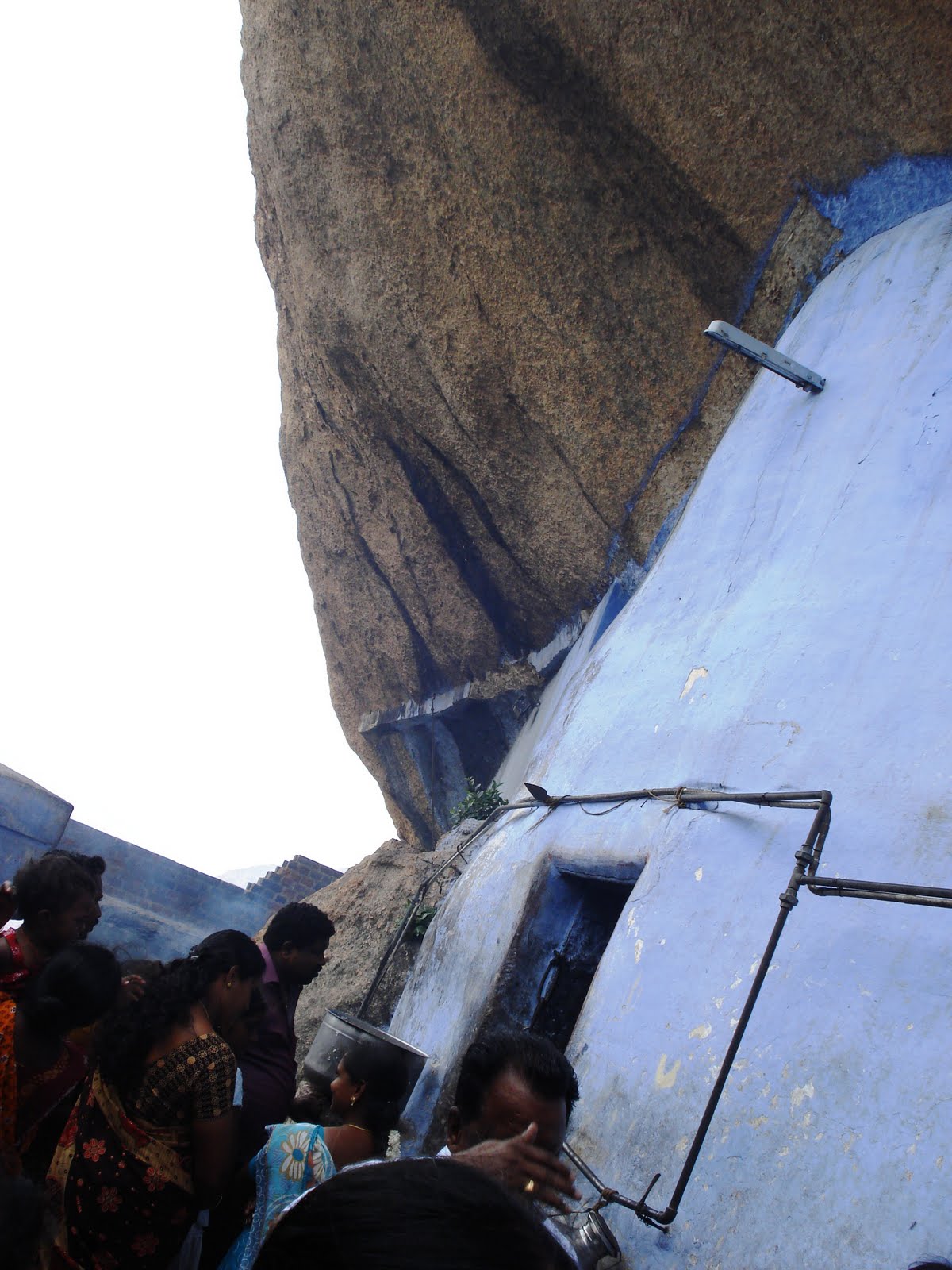
So what was so special about this temple? What was "Thirukkodi"? To whom was the offering made? Enough questions for a reality tv show. To quickly find out, let us move on. We soon reached the top of the hill. For a moment, I caught my breath. In front of me, was a rock, closely the size of Krishna's butter ball in Mahabalipuram, under which was this small concrete structure which housed the shrine of Sri Varadarajaswamy. I tried my best to capture the entire rock and the temple through my camera, but the space I had ,to work from was limited, and this was the best I got with my humble camera.


The magnificient entrance to the temple
There were several people waiting for the offerings to be made and the Thirukodi to be lit. My friend guided us into the shrine crowded with people jostling in the small space available between the rock and the sanctum sanctorum. The Sanctum Sanctorum was small and dark and we could see idols of Lord Varadaraja Perumal with Rama and Lakshmana covered in Silver Kavacham. The Priest was extremely busy attending to the several devotees.
The Sanctum Sanctorum inside the cave
When he came out, I asked him about the history of the temple, and the reason why the place was called Orukkamalai. He went on to briefly narrate the story. About 100 years ago, this area used to be primarily used by cowherds to graze their cattle. One such cowherd discovered that there were naturally formed Vaishnavite Symbols (Sanku, Chakram and Naamam) inside a cave and a naturally formed Hanuman (it looked too perfect to be natural!) on the rock outside the cave. He then spread the news to his friends, who started worshipping these shrines every day.
The figure of Hanuman found on a rock outside
On one such day, a cow came to the temple area and lay down refusing to get up. The cowherd who was in a hurry to take the cow back to its owner, tried all tricks he knew to make the cow get up, but did not succeed. He then prayed to the Lord Varadaraja Perumal, that he would give One Paise ( ஒரு காசு ) as offering if the cow got up and reached its destination. The cow that had been so obstinate till then, got up without a whimper when called, and went along with the cowherd. The Cowherd was happy that his prayers had been answered and went home.
A View of the massive rocks outside the temple
He forgot all about his promised offering and went about his daily chores. One day passed, and then two and another, till it was almost a week after he had promised the Lord about offering a coin. The same cow, which was grazing outside the temple, came and lay down in front of the sanctum sanctorum. Any amount of coaxing or disciplining by the cowherd, did not make it budge from there. It was then that the cowherd remembered his promise to the Lord, and offered the coin. As soon as he did so, the cow got up and started walking. The Lord would not tolerate failure of promise of even one coin - which is why the place came to be known as " ஒரு காசு பொறுக்கா மலை" (Oru Kaasu Porukka Malai) which abbreviated to "Orukkamalai".
A view outside the Sanctum Sanctorum
 People pray here for various things and once their wishes are answered offer "Thirukkodi". "Kodi" is the term used for new clothes in tamil and Thirukodi is a new dhoti that is used a wick to burn oil in a huge lamp that is placed on an ancient lamp post outside the cave. Several Thirukodis are lit in a day depending on the number of offerings made. For every thirukodi, there is a pooja and offering of food. 
The lamp post on which the Thirukodi is lit
The food that is offered to the Lord is cooked within the temple. A huge cake of steamed rice, with bananas mashed and placed over it are offered for each Thirukodi that is lit. The size of the wick and the amount of oil used depend upon the money that the devotee has promised to offer to the Lord. We wanted to watch a Thirukodi being lit, but the previous one had just happened a few minutes ago,  and the Poojari said that we had to wait atleast for an hour before the next one. So we gave him the money that we had promised to offer to the Lord and asked him to perform the ritual on our behalf .
Food being cooked inside the cave to be offered to the Lord
Several questions were buzzing in my mind - The poojari had mentioned that the idols of Varadaraja Perumal, Rama and Lakshmana were installed subsequently, and the silver Kavachams (armours) covering them were removed and taken away to the priest's house for safeguarding every evening. So, why was there no idol of Sita or any other goddess? What was the significance of having Rama and Lakshmana with the Varadaraja Perumal? Why did he come to be called so? Well, he was too busy to answer and none of the localities seem to know. There were a lot of figurines lined up along the rock in front of the Sanctum Sanctorum.
Possibly a King? or a Chieftain?
Who is this?
Some of them seem to believe that it was the idols of Ponnar - Sankar, while the others do not know who it was. The idols have been decorated with flowers with Kumkum applied on the forehead, but their identities are yet to be strongly established. We now move out of the temple with the rice cake with mashed bananas in our hand, in order to complete the offering that was promised. This according to me is what sets this temple apart from any other that I had seen or heard.

There are supposedly around 3000 monkeys on the hill. These are considered as an incarnation of Hanuman and any offering of food that is made to the Lord is shared with these monkeys. It is an amazing sight to watch several of them on the huge rock in front of the temple, waiting patiently for their share of the food. The localities say that they seldom attack visitors (unlike in other temples) and snatch away food, but wait till they are offered. Several people bring bananas, fried gram, groundnut and other produce from their fields as an offering to these monkeys so that their next yield is productive. The localities also say that the monkeys eat only prasad and they would often go without food during rainy season when it is difficult for people to access the temple.

This to me was the most satisfying thing about this temple. Feeding so many animals, who come so near you, but are so well behaved was really exciting. In fact, they say that the Poojari comes every day and feeds the monkeys even if there are no offerings made by the public, which I think is a really compassionate act. He says they wait patiently till the abhishekam and the pooja are over before moving close to the temple to claim their food.
I still had several bits of information about this temple missing, but we had to move on, to keep up with our schedule. If any of the readers of this post can provide more information on the history of this temple it would be extremely useful.
I had shot several pictures of the monkeys but just sharing a few here. It was a delight watching them, so serene, absolutely uncompetitive,waiting to be served!

We started our descent. This place is indeed special and a must visit if you have the inclination and physical ability. Orukkamalai is on the Salem Erode National Highway NH 47, after you cross Sankagiri, you will find Ashok Leyland and MRF Retreads SLUS Building on the right, turn left opposite this building and it will take you to the foothills. Caution: There is a Sign Board on the Highway indicating this left turn which mentions Orukkamalai as Korukkamalai, so dont be misguided. Try to carry some food for the monkeys if you are going on a day other than Saturday, when the temple is less crowded and there are less Thirukodis lit. 
I request readers of this post to share any additional information about the history of the temple that they are aware of.

Monday, September 27, 2010

1008 Shiva Temple, Salem

A view of the hillock of 1008 Shiva temples from the starting point!

1008 Shiva temples on a hillock! Surprised! Vinayaka Mission Institutions, Salem has built 1008 Shiva temples with identical Nandis in front of them all over a hillock on the Salem - Sangagiri highway on the right just after crossing the Vinayaka Mission Institutions.
Ganesha - Muzhumudharkadavul at the starting point

A huge Vinayaka greets you at the foothills, and the guard is very helpful in guiding devotees on how to go up the hillock by walk/by car. I would suggest walking up if time and health permit as it gives ample time to stop at each lingam, named after the sahasra namas of Lord Shiva, and offer prayers.

Beautiful settings as we go up the hill at dusk
The surrounding greenery, and the Sangagiri mountains at a distance, create an ethereal sense of serenity.  The lingams are interspersed with other sannadhis of Lord Muruga similar to those at the Aru padai Veedu, Raja Rajeshwari, Anjaneya, Mahalakshmi, Venkatesa perumal among others- all magnificient, the deities beautifully sculptured and maintained extremely well despite the size and location.

Replica of Thiruparankundram - one of AruPadai Veedu temples 
A special mention is definitely required about the main deity on top of the hillock - Sri Umaiyambigai Samedha Sri Arunachala Sundareswara. When one beholds him, all the effort of going up the hillock vanish. He is so huge and magnificient - a true jewel on the crown of the hillock. They say the height of the lingam is about 17'
The gopuram of Arunachala Sundareshwara seen from the foothill

As it is on the By - Pass, this temple is easily accessible to devotees who travel by road and on a weekend there are several devotees who come from other parts of the city and spend a quiet and serene evening here amidst nature and divinity.
More lingams as we go down

Definitely stop by if you happen to travel that side ! You can also read this post from  http://salem360.blogspot.com This website also has a lot of interesting info about Salem.
A panoramic view from our car as we move down the hillock reluctantly !!